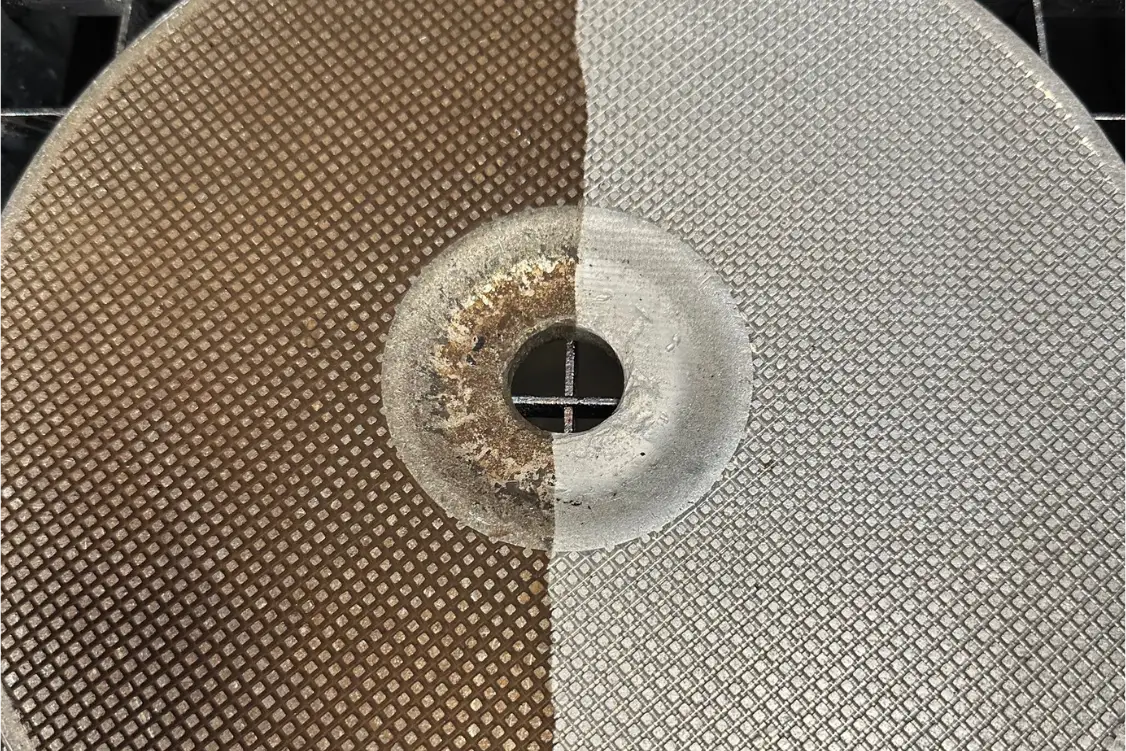
The principle in brief
Laser cleaning is removal by light. A pulsed laser sends tens of thousands of short light pulses onto the surface every second. Each pulse lasts only nanoseconds, billionths of a second, and lights an area a few millimetres across. Rust, paint, oil and grease absorb this light, heat up abruptly and evaporate or spall off. Specialists speak more generally of surface layers or contamination.
The technical term is laser ablation. It covers any removal of material with laser radiation, including engraving and drilling. It is called laser cleaning when only what does not belong to the part is removed.
A scanner in the processing head lines the pulses up with an overlap. To the eye this forms a continuous line a few centimetres long. The operator moves it across the surface like a wide brush.
Laser ablation: what happens on the part
Fraunhofer ILT names two mechanisms that usually act together. In the first, the layer evaporates or decomposes. In the second, thermal stresses and shock waves blast it off: the sudden heating puts the layer under stress, and the plasma that forms sends a pressure wave after it. According to a 2025 study, blasting off dominates with rust and evaporation with oil.
Schematic, not to scale
Enough energy for the layer, too little for the metal
Energy density of the pulse →
Below the ablation threshold. The pulse warms the layer but does not detach it. The surface stays as it is.
Inside the process window. The layer absorbs the energy and is removed pulse by pulse. The exposed metal can take more and stays unchanged.
Above the threshold of the base metal. The layer is gone, but the metal surface also starts to melt or discolour.
- Laser beam: the scanner in the processing head moves it across the surface as a line.
- Layer: rust, paint, oxide or oil.
- Base metal.
- Extraction: captures particles and fume where they arise.
The decisive quantity is the energy density, the energy of one pulse in relation to the area it hits. Below a threshold nothing happens, however often the beam passes over the spot. Above it, removal begins. The layer has one such threshold and the base metal a second. If the second is higher, there is a process window between them. The graphic shows the three cases.
No table tells you where the thresholds lie. Published values range from 0.2 to 25 J/cm², depending on the layer, the material, the pulse duration and the overlap of the pulses. Suitability is therefore decided by a trial on the part, not by the data sheet.
Why the metal stays, and when it does not
Two properties protect the base metal. The first: it absorbs less light than the layer. Polished iron absorbs a good third of the radiation at the wavelength of a fibre laser, cold-rolled mild steel about half, and hot-rolled steel with its oxide skin more than 80%. Iron oxides raise the absorption whether they sit on the steel as mill scale or as rust.
The second: metal conducts heat away quickly, and the pulse is over before the heat builds up. Once the layer is gone, the next pulse hits bare metal and does nothing more there. Fraunhofer ILT calls a process like this self-limiting and says it is usually the case on metal.
Usually does not mean always. The metal suffers in three cases:
- The energy density is above its threshold. Then the surface begins to melt. In one trial on aluminium the paint was removed at 16.5 W of laser power, but the base material had already melted slightly.
- The beam moves too slowly or passes once too often over the bare spot. Steel then gets a blue-black oxide film.
- The laser runs in continuous-wave mode. Heat builds up, and the risk of distortion and oxidation rises.
The German accident insurers put it in half a sentence: cleaning is gentle and free of damage “with suitable process parameters”.
Pulsed or continuous wave
There are two operating modes. A pulsed laser delivers its energy in short bursts, a continuous-wave (CW) laser without interruption. At the same average power, the power within the pulse is many times higher.
Pulsed
Short pulses with pauses in between
- pulse
- average power
Heat input into the part: low
- Power within the pulse is far above the average power.
- The layer is removed before heat travels deep into the part.
- For thin sheet, moulds and dimensionally critical parts.
Continuous wave (CW)
Power is applied without a pause
- power in the beam, which is also the average power
Heat input into the part: high
- The beam delivers energy continuously, so the part heats up much more.
- Thick layers over large areas go faster.
- For solid steel parts that conduct heat away well.
Pulsed lasers with pulses of a few tens to a few hundred nanoseconds are the usual choice for cleaning because they heat the part least. Continuous-wave lasers are used for large areas where heat matters less. The page pulsed laser cleaners shows how the models in our range work and what QCW means.
Fibre laser and CO₂ laser: the difference
Cleaning lasers for metal are almost always fibre lasers today. Their light has a wavelength of about 1064 nm, roughly a thousandth of a millimetre. CO₂ lasers emit at 10,600 nm, ten times longer. Both are in the infrared and invisible to the eye.
Wavelength
Both laser types work in the invisible infrared
- Ultraviolet
- Visible light
- Infrared
For metal the wavelength makes a big difference. Steel absorbs only a few percent of the radiation at 10,600 nm, and about 37% at just over 1000 nm. Plastics, wood and glass behave the other way round and absorb the light of the CO₂ laser strongly. That is why the CO₂ laser mainly processes organic materials and the fibre laser metal.
The second difference is practical. Light with a wavelength of 1 µm can be guided through a glass fibre cable. The machine stands in the corner while the operator works with the processing head on a cable several metres long. No such fibres exist for high-power CO₂ radiation.
The CO₂ laser has not disappeared from cleaning. It is still used, depending on the material, and is considered less risky for the eye. The invisible beam of the fibre laser, by contrast, reaches the retina. That is the reason for the strict rules explained in the guide Laser safety for laser cleaning.
What a laser cleaning machine consists of
A laser cleaning machine, or laser cleaner for short, has four parts. The mobile base unit holds the laser source, the cooling and the control. Small machines are air-cooled, larger ones water-cooled. A flexible light guide cable carries the light to the processing head, which the operator holds. For the models in our range it is usually 10 m long, according to the manufacturer.
In the head, a lens focuses the beam, and a scanner with fast oscillating mirrors, a galvanometer scanner or galvo for short, draws it into a line. The fourth part is the extraction. It sits on the head or stands next to it and takes up what the laser removes.
What can be set on the machine
Whether a task lies in the process window is decided by a handful of settings. The operator selects most of them on the machine and controls two by hand.
| Setting | What it does |
|---|---|
| Average power | determines how much area per hour is possible |
| Pulse duration and pulse energy | define how hard each pulse hits |
| Pulse frequency | defines how closely the pulses follow one another |
| Scan width | a wider line covers more area per stroke but spreads the energy thinner |
| Scan speed | controls how much the pulses overlap |
| Distance to the part | the energy density is only right in focus; the hand keeps it |
| Number of passes | thick layers need several; the hand sets the pace |
How fast it all goes depends on the same settings and on the layer. One manufacturer quotes these area rates per hour for a 500 W system: 15 to 20 m² for de-oiling, 5 to 10 m² for light oxide layers, 3 to 10 m² for paint and 3 to 6 m² for release-agent residues in moulds.
Cleaning without chemicals or water: what the laser needs and what it does not
Unlike conventional methods such as blasting or pickling, laser cleaning works without abrasives, without solvents and without water. At most, what sat on the part beforehand remains as waste, and some of that turns to ash during processing. That is how Fraunhofer ILT puts it.
That does not make the process residue-free. In a closed room without extraction, an average of more than 7000 µg of particulate matter (PM10) per cubic metre of air was measured during laser rust removal. The German accident insurers (DGUV) require fume and vapour to be captured at the source and extracted. As possible hazardous substances from old coatings they name red lead, chromates, zinc and fillers containing asbestos.
Also needed: electricity, a demarcated working area and protective eyewear. The process is not loud: according to the DGUV the level is usually below 80 dB(A).
Where laser cleaning is used
In production it mostly serves as preparation. Before welding, brazing or bonding, the laser removes oil, grease, oxides or coatings from exactly the spot that will be joined. In the automotive industry this usually runs automatically in the line. One manufacturer reports a ring gear whose phosphate layer the laser removes in less than 10 seconds.
In maintenance the subjects are moulds and tools with release-agent residues, machine parts and individual rust spots. On large steel structures such as bridges, halls or wind turbine towers, the laser removes weathered old coatings, rust and oxides before recoating. Fraunhofer ILT names leaving intact protective layers in place as the difficulty there.
Where laser cleaning reaches its limits
- Thick layers. From about 0.5 mm, removal is generally regarded as uneconomical, especially over several square metres.
- Mill scale. A pulsed laser does not remove firmly adhering mill scale economically. It is blasted or removed mechanically.
- Hidden areas. The beam needs a clear line of sight. Winding tubes and cooling channels cannot be cleaned.
- Very large areas. Blasting is faster here, and laser manufacturers say so themselves.
- Plastic as the substrate. If the substrate absorbs the light about as well as the dirt does, the contrast the process depends on is missing.
- Burrs and limescale. Deburring and the removal of mineral deposits are not possible.
What this means for choosing a machine
The principle leads to the questions to settle before buying. Which layer sits on which material, and how thick is it? That decides the operating mode and power class. How large is the area per job? That decides whether 100 W is enough or 1000 W is needed. What happens to the part afterwards? That decides whether a bare surface is enough or a certain roughness is required. The buying guide goes through these points in turn.
Which power do you need, and what does it cost?
State the material, the layer and the area. The quote names the power class and the price.
The most common tasks have their own pages: rust removal, paint removal and surface preparation.