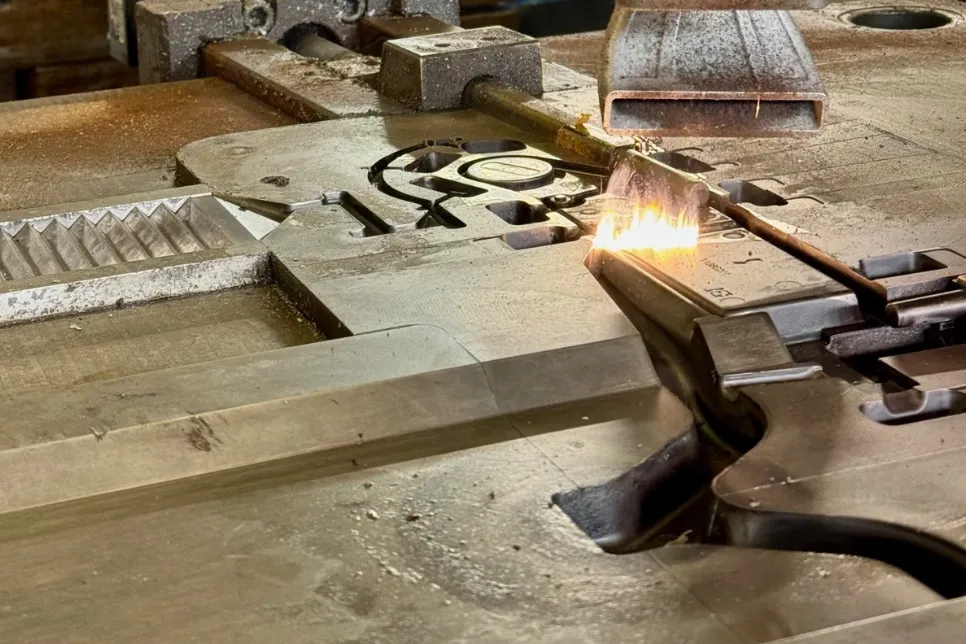
What a pulsed laser does differently when cleaning
A pulsed laser, also sold as a pulse laser cleaning machine, emits its light in separate pulses. In cleaning lasers a pulse lasts from a few tens to a few hundred nanoseconds, and between pulses the laser is off. For that instant the power is far above the figure on the rating plate. One manufacturer puts it this way: a pulsed laser with 100 W average power reaches 10,000 W in the pulse. A continuous-wave laser with 1,000 W never exceeds 1,000 W.
That difference is what matters in cleaning. The high power in the pulse vaporises rust, paint and other contaminants, and the short duration gives the heat little time to travel into the component. Heat conduction cannot be suppressed completely, but it is reduced substantially. This is why nanosecond lasers are the usual choice for precision cleaning and for heat-sensitive materials.
How the process works in detail is covered in How does laser cleaning work?. This page deals with two questions that come up before buying a pulse laser cleaner: what do the figures on the data sheet mean, and when is a continuous-wave laser enough?
Four figures on the data sheet of a pulsed laser
The average power in watts is in every quotation. It tells you how much energy the laser delivers per second. It says nothing about the single pulse. For that you need three more figures.
The pulse energy in millijoules is the energy one pulse contains. The pulse duration in nanoseconds is the time in which it arrives. The repetition rate in kilohertz counts the pulses per second. The four are linked: average power divided by pulse energy gives the repetition rate. Pulse energy divided by pulse duration gives roughly the peak power.
Calculator
What a data sheet reveals about the pulse
Enter three values from a data sheet or pick an example. The examples come from published documents and are not data for the models in our range.
Please enter three values greater than zero.
Repetition rate20 kHzpulses per second
Peak power in the pulse157 kWapproximation, see below
Peak versus average783×that much above the wattage
Emission time0.12 %of the time; otherwise the laser is off
- 200 W · 10 mJ · 60 ns: repetition rate 20 kHz, peak power about 157 kW, 783 times the average power; the laser emits 0.12 % of the time.
- 200 W · 1.5 mJ · 100 ns: repetition rate 133 kHz, peak power about 14 kW, 70 times the average power; the laser emits 1.3 % of the time.
- 1000 W · 100 mJ · 70 ns: repetition rate 10 kHz, peak power about 1.34 MW, 1,343 times the average power; the laser emits 0.07 % of the time.
The two 200 W examples show why the wattage alone says little. Both lasers deliver the same power on average. One spreads it over 20,000 large pulses per second, the other over about 133,000 small ones. At the peak that is roughly 157 kW against roughly 14 kW, a good ten times more.
Which of the two cleans better depends on the layer. In one published test a pulse duration of around 100 ns removed paint more easily than longer pulses, and a low pulse frequency was more likely to attack the base metal. On pulsed fibre lasers with a MOPA design, pulse duration and repetition rate can be adjusted. Ask which ranges the quoted machine covers and which setting would be used on your component.
Pulse energy and pulse duration of the models in our range are stated in the quotation for the specific configuration.
Pulsed or continuous wave (CW): the differences
A continuous-wave laser, CW for short, emits continuously, without interruption. Technical sources assign the two modes as follows: pulsed nanosecond lasers for precision cleaning, continuous-wave lasers for large areas where heat matters less.
A direct comparison was published in 2021 by a maker of laser sources in the trade journal Laser Focus World. It cleaned painted samples of an aluminium alloy and of carbon steel, once with a pulsed fibre laser and once with a continuous-wave laser of the same average power.
Manufacturer's test, same average power
Area rate: pulsed against continuous wave
Aluminium
Steel
The pulsed laser was 7.7 times as fast on aluminium and 3.5 times as fast on steel. What happened to the surface matters more. After the continuous-wave laser the samples were darker, the base metal had melted under the microscope, and the roughness was 1.5 times the original value. After the pulsed laser the surface was as smooth as before or smoother.
The test comes from a supplier of pulsed sources and applies to those samples. Its direction matches a scientific study on non-stick fluoropolymer coatings: a nanosecond laser detached the coating mechanically, while a 200 W continuous-wave laser charred it.
With a continuous-wave laser a great deal depends on speed. If the beam moves too slowly, it damages the base metal. If it moves too fast, coating is left behind. That does not make it useless. For large steel structures and pipes, which shed heat quickly and make lower demands on the surface, the same manufacturer calls the continuous-wave laser a good choice. It also costs less to buy.
| Pulsed lasernanosecond pulses | Continuous-wave laserCW, no pause | |
|---|---|---|
| Moulds, tools, mating surfaces | well suited: the usual choice, the contour stays | unsuitable or risky: base metal can melt |
| Thin sheet, heat-sensitive parts | well suited: lowest heat input | unsuitable or risky: heats the component noticeably |
| Large steel structures, pipes | suitable with limits: possible, a question of power class | well suited: a good choice if the surface allows it |
| Surface after cleaning | well suited: roughness as before or lower | suitable with limits: darker, 1.5 times the roughness in the test |
| Wrong settings | suitable with limits: too low a pulse frequency can attack the metal | unsuitable or risky: too slow damages, too fast does not clean |
| Standard for steel preparation | well suited: AMPP SP21511-1 (2024) covers pulsed lasers | suitable with limits: parts for continuous wave are planned |
| Purchase | suitable with limits: more expensive | well suited: costs less |
well suitedsuitable with limitsunsuitable or risky
QCW: the third operating mode
QCW stands for quasi-continuous wave. The laser is switched on only for intervals. They are long enough for it to work as it would in continuous operation and short enough for it to heat up much less. The share of on-time can be just a few percent. During those intervals the laser can deliver more power than in continuous operation.
This should not be confused with a nanosecond pulsed laser. A continuous-wave laser can also be switched on and off electronically; such a modulated laser is still a continuous-wave laser while it is on. A pulsed laser in the strict sense delivers short bursts of high intensity. If a quotation says “pulsed”, it is worth asking which of the two is meant.
What is a fibre laser?
The word describes the design, not the operating mode. In a fibre laser the light is generated in a glass fibre doped with ytterbium. Such fibres emit at 1.0 to 1.1 µm; the data sheets of cleaning lasers usually state 1064 nm. Fibre lasers exist as pulsed and as continuous-wave machines. They also cut, weld and mark, and anyone searching for a fibre laser (or fiber laser) often means one of those machines.
For cleaning, the design has a practical advantage: the light travels through a flexible fibre cable to the processing head. The machine stays where it is and the operator works at the component with the head. According to the manufacturer, the models in our range have 5 or 10 m of fibre. For larger installations other manufacturers offer lengths of up to 50 m.
With pulsed fibre lasers you will come across the abbreviation MOPA. It stands for master oscillator power amplifier: a small laser sets the pulses and an amplifier raises them to full power. Why metal absorbs the light of a fibre laser better than that of a CO₂ laser is explained in the article on how laser cleaning works.
Power classes: from 100 W to 2000 W
A buyer’s guide to laser cleaning machines gives these example values: 100 to 300 W is common for handheld units, and the kilowatt class is meant for heavy rust and paint. Mobile units are air-cooled; above 500 W water cooling is the rule.
In our range it looks like this. According to the manufacturer, the air-cooled models with 100, 300 and 500 W weigh 39 to 40 kg and run on 230 V. The water-cooled models with 500, 1000 and 2000 W weigh 240 to 250 kg; from 1000 W they need a three-phase 400 V supply. The table above shows the data side by side.
How much area a power class covers depends on the layer. Manufacturer tables on this are on the rust removal and paint removal pages. Whether a 100 W, 200 W or 1000 W laser suits your task is decided by area and layer thickness, not by the number alone.
Which models are pulsed
According to the manufacturer, ROD 100 Air, ROD 300 Air, ROD 500 Air, ROD 500, ROD 1000 and ROD 2000 are pulsed lasers with 100 to 2000 W average power. DIVA 3000 is a continuous-wave laser with 3000 W.
What to clarify before buying a pulsed laser
The answers require the supplier to know your task. State the base material, the layer structure and the area. Define which changes to the component are acceptable and how the result will be judged. If the surface is to be bonded, coated or welded afterwards, the requirements of that step belong in the enquiry.
One successful application example is not a commitment for every surface in your plant. Ask where the limits of the proposed configuration lie. The term pulsed laser alone does not mean that the base metal stays unchanged: with the wrong settings a pulsed laser attacks the metal too.
Also ask about maintenance and running costs of the quoted configuration. The price and costs page shows what operation involves.
Pulsed or continuous wave: what does the right configuration cost?
Tell us the material, the layer and the surface you need. The quotation states operating mode, power class and price.
The buying guide helps you put this information together for a specific equipment enquiry.