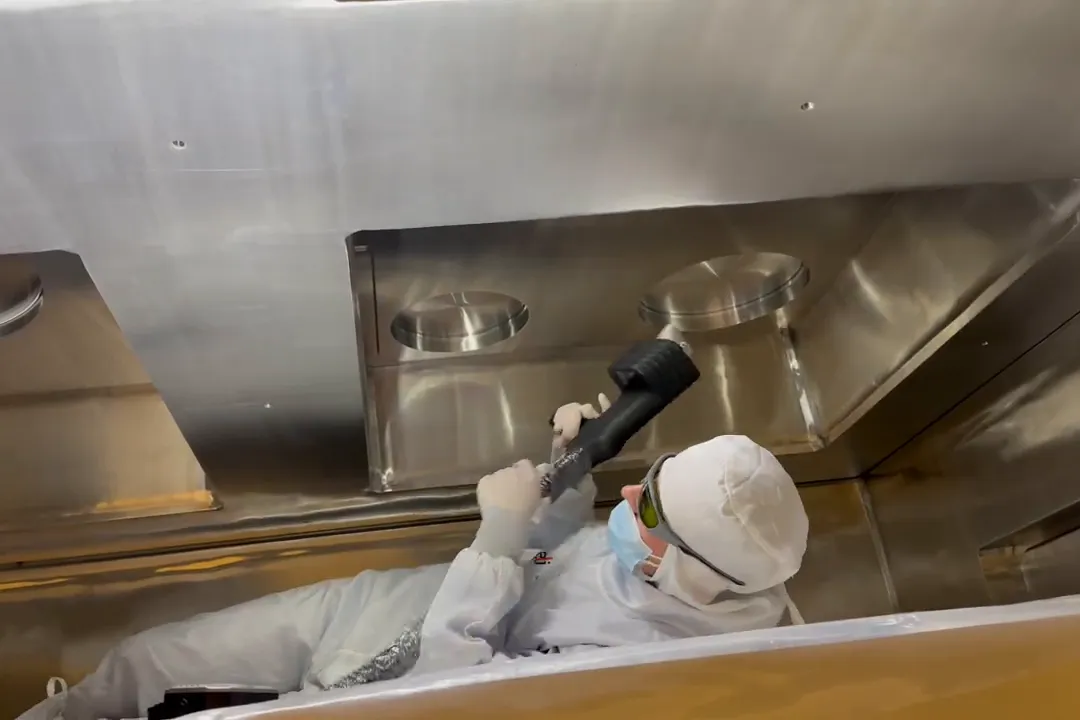
Laser class 4: what that means
Cleaning lasers belong to laser class 4, the highest. The German technical rules describe laser radiation of this class like this: very dangerous for the eye, dangerous for the skin, and even diffusely scattered radiation can be dangerous. Fire and explosion hazards come on top.
Two properties make the beam treacherous. It is invisible, because cleaning lasers work at 1064 nm in the infrared; the eye sees nothing and does not turn away. And it stays dangerous over long distances. What you see glowing red or green on the part is only the pilot laser that shows the working position.
Since June 2024 the German accident insurers have had a dedicated paper for handheld cleaning lasers, DGUV document FBHM-139. It is the best basis for the risk assessment and contains a checklist and a model operating instruction. Buyers of cheap machines should know one sentence from it: laser equipment without a recognisable laser class must not be used for surface treatment.
How far the beam stays dangerous
The DGUV works through an example: a handheld machine with 300 W at 1064 nm. The chart shows the distance from which the limit values for eye and skin are met.
DGUV worked example, 300 W
Distance from which the limit values are met
Eye
Skin
So the direct beam is only harmless to the eye after 49 m. A reflection that returns just 15% of the power reaches 19 m. Even with ideally uniform scattering, a laser area of about one metre remains. The machines in our range have 100 to 3000 W, and the distance grows with the square root of the power.
Metal reflects. At the start of processing almost all of the radiation can be reflected, and angles, tubes or weld seams send it in unexpected directions. That is why the rule is never to aim the beam at reflecting surfaces, and why “I’ll be careful” is not a safety concept. With this class of machine, laser safety is a matter of preparation.
What the employer has to do
The basis is the German occupational safety regulation on artificial optical radiation, the OStrV. It requires four things before the laser runs for the first time.
First, a risk assessment. It has to come from a competent person. If the employer does not have the knowledge himself, he takes competent advice.
Second, protective measures in a fixed order: technical before organisational, and personal protective equipment only when both are not enough. Areas where limit values can be exceeded must be marked clearly and permanently, demarcated and closed to unauthorised persons.
Third, instruction: before work starts, then at least once a year and immediately after significant changes. Date and names are recorded in writing, and an operating instruction is kept at the workplace. Whoever operates the machine also needs training on the machine, for example from the manufacturer.
Fourth, the laser safety officer. More on that below.
Omitting these duties is an administrative offence. The fine is up to €5,000. The OStrV does not, however, provide for notifying an authority of the laser. The old notification duty was in DGUV Vorschrift 11, which BGHM withdrew as of 14 November 2019 and BG ETEM as of 1 April 2023.
Laser safety officer: who needs one and how to become one
The laser safety officer (in German Laserschutzbeauftragter, LSB for short) is the person in the business who knows the laser and supports the employer on occupational safety. The main points on duty, requirements, course and cost:
When? Before operating lasers of classes 3R, 3B and 4. The appointment has to be in writing. It is only unnecessary if the employer has the required expertise himself.
What are the requirements? A laser safety officer can be anyone with completed technical, scientific, medical or cosmetic vocational training, or at least two years of comparable professional experience. The same person can also be the competent person for the risk assessment.
Which course? Expertise is proven by a course with a passed exam. The TROS Laserstrahlung gives 14 teaching units of 45 minutes as an example for the general course, which is 10.5 hours, and 8.5 teaching units for the application-specific course. The exam is a multiple-choice test with at least 15 questions. As a rule, 70% correct answers pass.
Online or in person? The sources contradict each other here. DGUV Grundsatz 303-005 requires a classroom course and accepts e-learning only as preparation. Many providers nevertheless sell live online courses, and the OStrV and TROS say nothing about the format. Before booking, ask your accident insurer whether it recognises the course.
What does it cost? Published course fees in October 2026 ranged from €370 net for an application-specific course to €1,250 net for a two-day basic course. Through the accident insurer, training can be free of charge for member companies.
How often to refresh? There is no statutory deadline. The TROS considers a one-day refresher within five years appropriate.
What does the officer do? Support the employer with the risk assessment, with the protective measures and with monitoring safe operation. The appointment should name tasks and powers, such as the right to switch the laser off when defects are found. Responsibility stays with the employer.
The laser area: demarcate, mark, indicate
The laser area is the area in which the limit values can be exceeded. If nothing shields it, that is the whole hall. The plan shows what a workplace consists of. Select an item in the list to see it in the plan.
Example, not to scale
A workplace for the handheld cleaning laser
A separate room or cabin is best. For medium-power lasers in the 100 W range, the DGUV says non-combustible walls of sheet metal or masonry are usually enough; high power may need a special design. The door gets a switch that stops the laser when it opens, and outside a warning sign and a warning light.
For changing locations, mobile protective walls and curtains help. Here the standard matters: screens to EN 12254 are only intended for up to 100 W average power. More powerful machines need protective walls to EN 60825-4. Free-standing walls also only protect sideways; the area stays open at the top.
Windows and viewing panels, sold as laser safety windows, count as shielding and must meet the requirements of EN 207 and EN 60825-4. A panel that has not been tested and marked for the wavelength of the laser is not laser protection, whatever it is made of. That includes acrylic glass.
If the area cannot be shielded sufficiently, the DGUV requires laser work to be separated in time from other work. The key of the machine then belongs in firm hands all the more.
Laser safety eyewear: reading the marking
Eye protection is the last stage of the safety concept and the one nobody can do without. Everyone in the laser area wears laser eyewear to EN 207, including people who only stand by. Whether a pair suits the machine is written on the lens or frame. The DGUV explains the marking with this example:
Marking to EN 207
What is written on laser safety eyewear
1064Wavelength. The eyewear protects at 1064 nanometres. The value has to match the wavelength of the laser. If a range is given, such as 900 to 1070, the wavelength of the machine has to lie within it.
DIOperating mode. D stands for continuous wave, I for pulses between one microsecond and a quarter of a second, R for giant pulses from one nanosecond to one microsecond, M for even shorter pulses. With pulsed lasers, D always has to fit in addition to the pulse mode.
LB7Protection level. At LB7 the filter transmits at most one ten-millionth of the radiation. The level also states which irradiation lens and frame withstood in the standard test: for at least 5 seconds and 50 pulses.
XManufacturer. Code letter of the eyewear manufacturer.
SStrength. Mark for the mechanical strength of the eyewear.
CECE mark. Laser eyewear is personal protective equipment and needs the CE mark. Stating only the optical density (OD), as is common in the USA, is not sufficient in Europe.
The protection level needed cannot be read from the wattage alone. It depends on what can hit the eyewear in the worst case. If the machine manufacturer has recommended a level, that one is used. As an order of magnitude, one eyewear manufacturer names levels D LB6 to D LB8 for handheld machines of 2 to 3 kW.
Three things are worth knowing about the eyewear. It protects against an accidental hit and is not made for looking into the beam. It does not block the glaring process light. And it ages: without manufacturer information it should be checked after ten years at the latest. In high-power applications, eyewear alone generally does not give sufficient protection. For handheld lasers BG ETEM therefore asks about a helmet or visor, together with eyewear where needed.
Skin needs protection too. The DGUV recommends closed, flame-retardant clothing as for welding. Ordinary cotton offers hardly any protection.
Fume, dust and fire hazard
What the laser removes hangs in the air as fume and fine dust, and the particles are small enough for the alveoli. The DGUV requires them to be captured as completely as possible at the source, ideally with extraction on the processing head. Its checklist puts it briefly: do not operate the laser without extraction.
How dangerous the fume is depends on the layer. Old coatings can release red lead, chromates, zinc, decomposition products of synthetic resins and fillers containing asbestos. Unknown coatings should therefore be analysed before work. Where nothing is known, the highest protective measures apply.
A particle filter does not stop gases. With coated metals and plastics the extracted air should therefore be led outside. If carcinogenic substances cannot be ruled out, the air may only return to the hall if a recognised process cleans it sufficiently.
And the laser is an ignition source. The DGUV classifies cleaning as hot work. Combustible material is removed from the working area, tanks and vessels have their own rules, and where fire loads remain a fire watch is assigned.
When buying: how to recognise a compliant machine
BG ETEM wrote in 2024 that not all handheld laser machines on offer meet standards and laws, and that necessary safety devices are often missing. In January 2025 German customs stopped the import of three laser welding machines from China that a metalworking company had ordered online. Documents were missing, the marking was incomplete, and market surveillance found that the Machinery Directive was not met.
So check before buying:
- Type plate with the full manufacturer address, CE marking and the laser class
- EC declaration of conformity and operating instructions in German
- Key switch, emergency stop and an indicator that signals laser emission
- Emission only while the operator holds the trigger
- A connection for external safety devices such as a door contact
- The safety distance stated for the machine
Anyone importing from a non-EU country themselves can legally become the manufacturer and then carries the manufacturer’s duties. From 20 January 2027 the new EU Machinery Regulation applies. The German implementing act then expressly requires operating instructions and declaration of conformity in German.
Ask for the price of machine and supply scope
Ask at the same time about laser class, documents and safety distance, and which safety equipment is included.
Checklist: ready for first use?
The list sums up what has to be in place before commissioning. It draws on the checklists of the DGUV and BG ETEM. Tick what is done and copy the status for your records.
Before commissioning
Laser safety checklist for the cleaning laser
17 points in four groups. The list is a working aid and does not replace a risk assessment.
0 of 17 points settled
This article summarises German regulations and rules as of October 2026. It does not replace the risk assessment, the documents of the machine or legal advice. The guide How laser cleaning works explains the process itself. The models with laser class and mains supply are listed under laser cleaning machines.