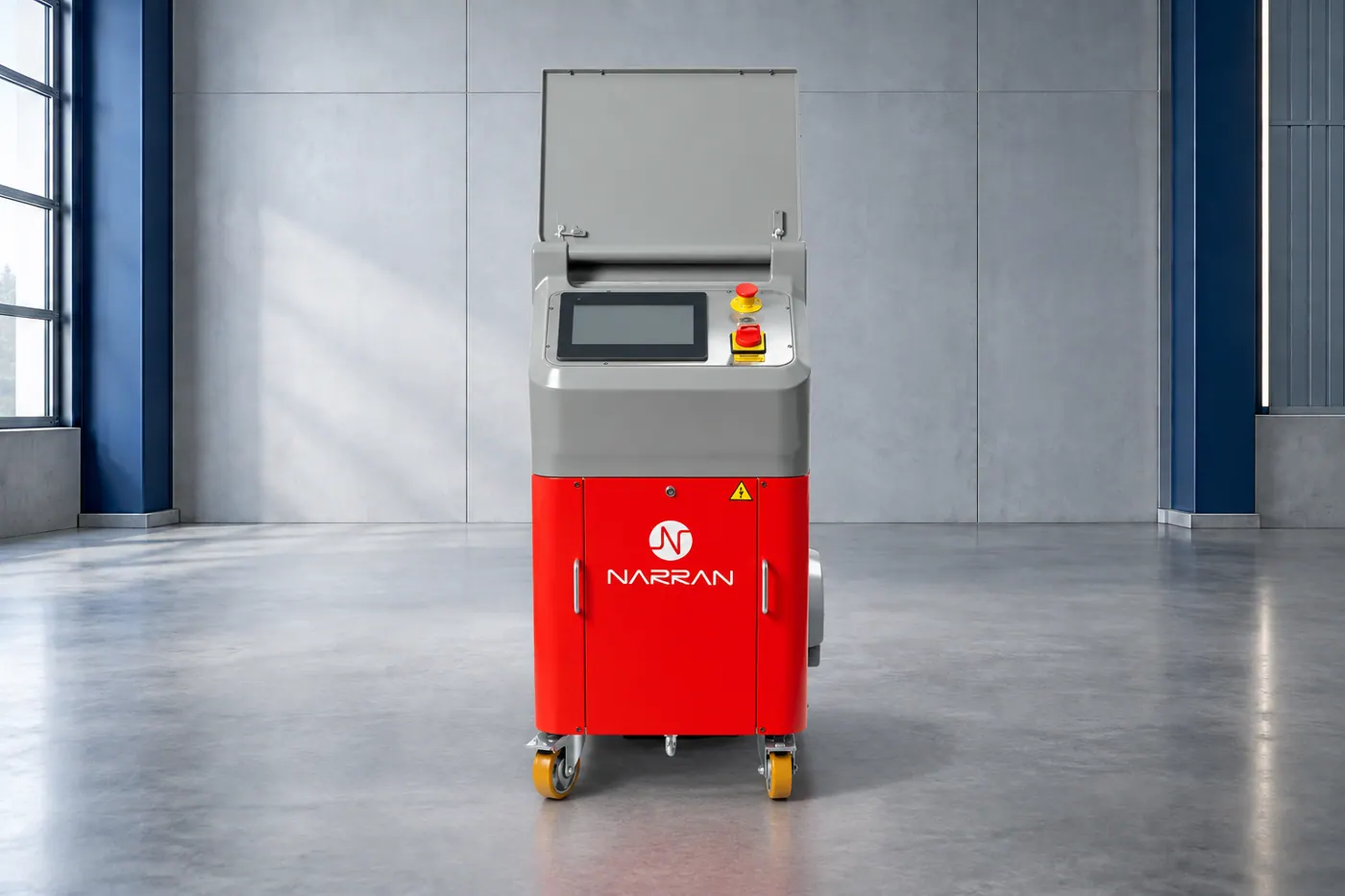
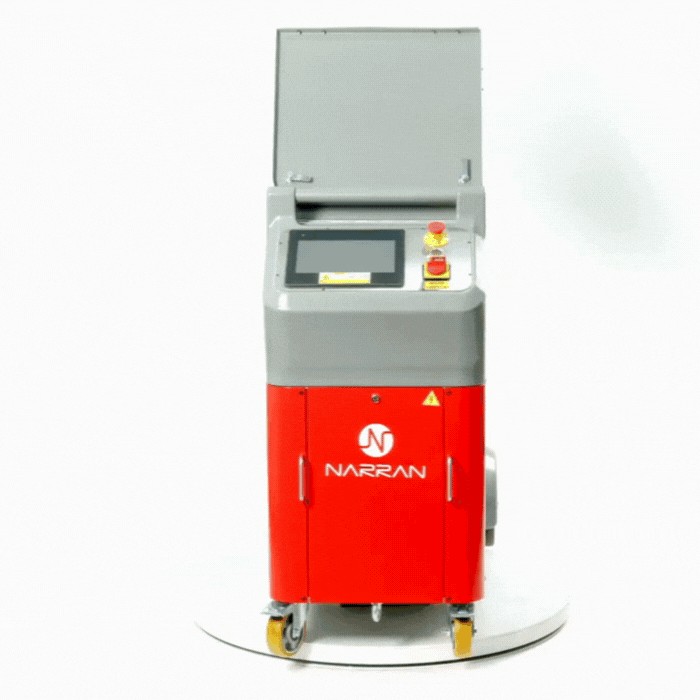
DIVA 3000: the continuous-wave laser with 3000 W in the range
According to the manufacturer, DIVA 3000 is a water-cooled continuous-wave (CW) laser with 3000 W average power and Class 4. The ROD models, by contrast, are pulsed. We will state the power supply, weight, dimensions and fibre length of DIVA 3000 once the manufacturer has confirmed them; until then, the data sheet for the version quoted applies. When buying a 3000 W laser cleaning machine, look at the operating mode first and the wattage second.
What continuous wave changes in cleaning
A continuous-wave laser radiates without a pause, and the heat stays in the component. A trial published in 2021 by a manufacturer of pulsed laser sources shows how large the difference can be. It cleaned painted samples at the same average power, once pulsed and once in continuous wave. On aluminium the pulsed laser managed 2.77 m² per hour and the continuous-wave laser 0.36 m². On steel the figures were 1.06 against 0.30 m². After continuous wave the samples were darker, the base metal had partly melted, and the roughness was 1.5 times the starting value.
The trial comes from a supplier of pulsed sources and applies to those samples. Its direction matches a study on fluoropolymer non-stick coatings, in which a 200 W continuous-wave laser charred the layer while a nanosecond laser lifted it off. The page on pulsed laser cleaners explains how the two modes work.
Where a continuous-wave laser fits
The same manufacturer calls continuous wave a good choice for large steel structures and pipes that conduct heat away quickly and place lower demands on the surface. It also costs less to buy than a pulsed laser. In exchange, a great deal depends on travel speed. If the beam moves too slowly, it damages the base metal. If it moves too fast, coating is left behind. Moulds, fitting surfaces, thin sheet and heat-sensitive parts are not what you would test a continuous-wave laser on first. For those, ROD 2000 in pulsed mode is the closer choice.
If your client bases the work on the US standard AMPP SP21511-1 for laser preparation of steel, ask first. It covers pulsed lasers, and parts for continuous wave are only planned.
Laser safety at 3000 W
With continuous wave, the protective eyewear marking to DIN EN 207 has to include a D. A manufacturer of eyewear gives the protection levels D LB6 to D LB8 as a guide for handheld machines of 2 to 3 kW. What counts is the risk assessment and the recommendation of the machine manufacturer. The safety distance grows with the square root of the power. At 3000 W it therefore exceeds the DGUV worked example for a handheld machine with 300 W, where the direct beam is safe for the eye only beyond 49 m. Heat matters too. The DGUV classes laser cleaning as hot work, so combustible material has to leave the work area. The guide to laser safety in laser cleaning sets out all the duties.
What the quotation for DIVA 3000 has to settle
Ask for a current data sheet for the version quoted. The connection, cooling, dimensions, processing head and further equipment should be confirmed there, as should whether the head is guided by hand or built into a system. Describe the components, the areas, the existing coatings and the condition the surface needs afterwards. The buying guide helps you compare quotations, and the equipment overview shows the other models.
Questions about DIVA 3000
What power supply does DIVA 3000 need?
No confirmed figures are available. ROD 1000 and ROD 2000 need a 400 V three-phase supply according to the manufacturer. For DIVA 3000, ask for the figure in the data sheet before you plan the location.
When is a continuous-wave laser the wrong choice?
For moulds, fitting surfaces, thin sheet and sensitive surfaces, because it heats the component far more. The same applies when the surface has to stay unchanged after cleaning.