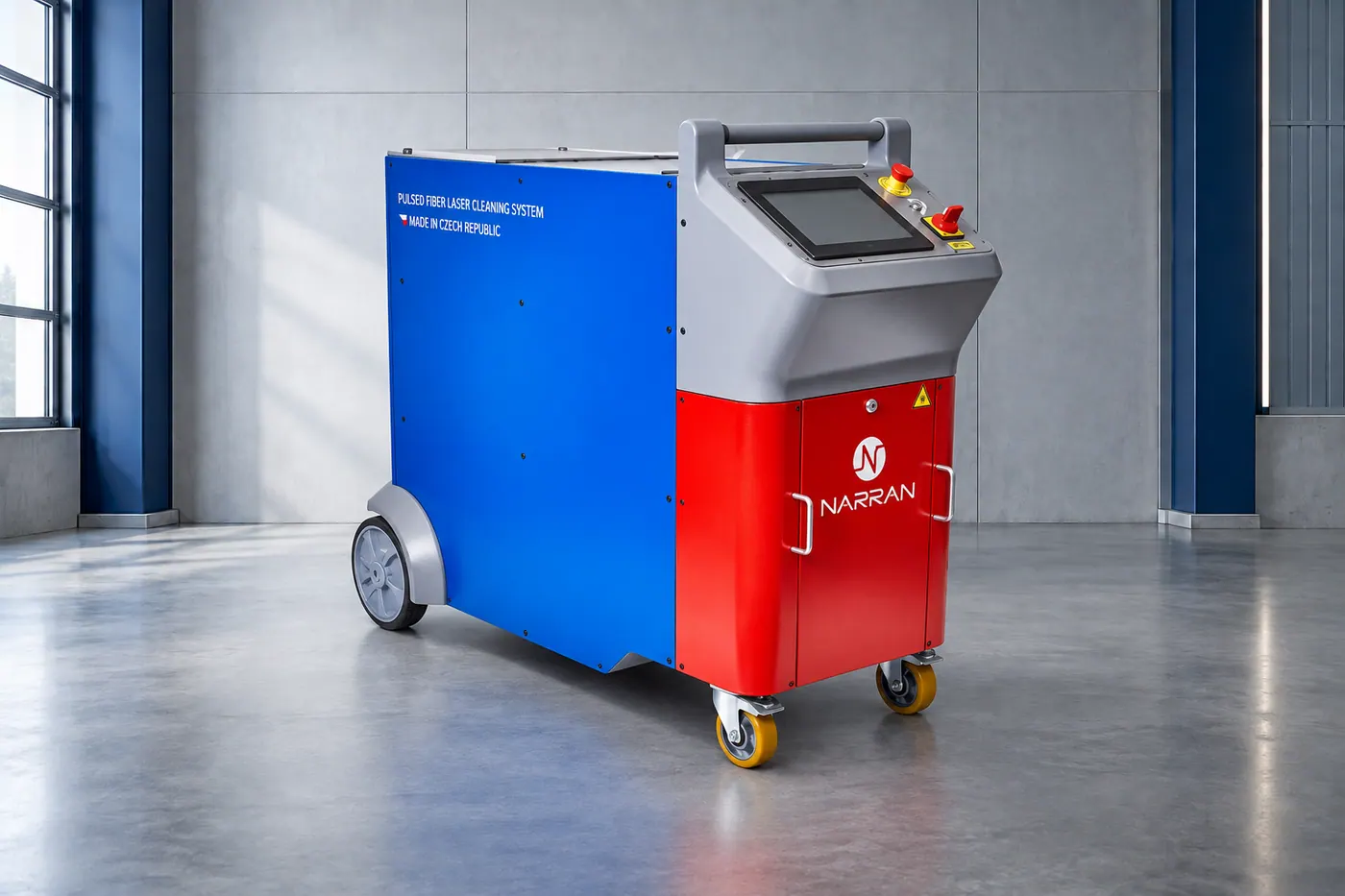
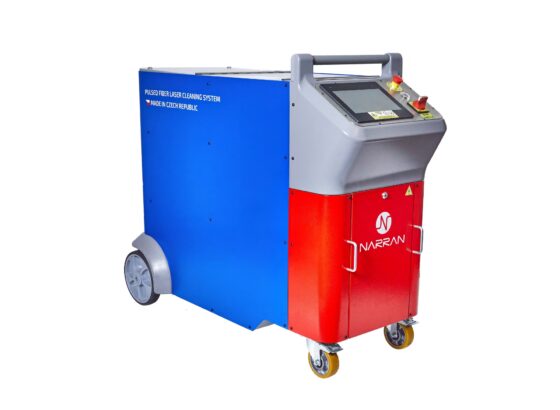
ROD 1000: a pulsed 1000 W laser cleaner on a three-phase supply
With ROD 1000 the kilowatt class begins. A buyer’s guide assigns it to heavy rust and heavy paint. According to the manufacturer, ROD 1000 is pulsed and water-cooled, weighs 250 kg and measures 140 × 64 × 112 cm. It needs a 400 V three-phase supply (3 + N + PE, 50 Hz), the fibre is 10 m long, and the laser is Class 4. Compared with ROD 500, the average power doubles in the same dimensions, and the connection changes from 230 V to three-phase.
Area and coating thickness at 1000 W
No measurements of ROD 1000 exist. A table from a manufacturer of pulsed fibre lasers offers a reference point. For stripping paint and powder coating, 1000 W covers 1.2 to 2.8 m² per hour at 100 µm coating thickness and 0.9 to 1.4 m² at 200 µm. For 500 W the same table gives 0.7 to 0.9 and 0.2 to 0.5 m². The area per hour falls sharply as the coating gets thicker, and that is where the extra power helps.
For individual spots and small parts, a kilowatt-class machine is more than you need. It earns its place on several square metres at a stretch. That is a rule of thumb, not a promise for your component.
Power, weight and space
The mains connection is the first hurdle with ROD 1000. A data sheet for another mobile pulsed laser lists about 7 kW power consumption for 1000 W of laser power, against 1.5 kW at 100 W. What ROD 1000 draws is stated in the connection data sheet for the configuration quoted. Before ordering, check whether a 400 V three-phase supply exists at the installation site, and check the route in and the floor space against 250 kg and 140 × 64 × 112 cm.
ROD 1000, ROD 2000 or Bright+?
ROD 2000 has twice the power in the same dimensions and with the same connection. It pays off only when area or coating thickness push ROD 1000 to its limit. The range also includes ROD 1000 Bright+. The model name alone does not establish technical differences. Put the documentation for both versions side by side and compare equipment and supply scope on the same task.
The next step and automation
If the part is welded, coated or bonded after cleaning, state the requirements of that step. The page on surface preparation shows how much they vary. If the same part is cleaned at the same spot every time, look at automated laser cleaning. Whether ROD 1000 can be integrated is something the quotation has to clarify.
Laser safety at 1000 W
Which protective eyewear is needed cannot be read off the wattage alone. If the machine manufacturer has recommended a protection level, that level applies. The eyewear must show the wavelength and operating mode, and for pulsed lasers the marking to DIN EN 207 needs a D for continuous wave as well as the pulse mode. For high-power work, eyewear alone is usually not enough; BG ETEM asks about a helmet or visor for handheld lasers. The remaining duties are set out in the guide to laser safety in laser cleaning.
Questions about ROD 1000
Does ROD 1000 need a three-phase supply?
Yes. According to the manufacturer it needs 400 V (3 + N + PE, 50 Hz). ROD 100 Air, ROD 300 Air, ROD 500 Air and ROD 500, by contrast, are specified for 230 V.
What belongs in an enquiry for ROD 1000?
The material, the coating and its thickness if known, the area per job and the step that follows. For a purchase, add the mains connection you have and the space for extraction and shielding. The buying guide puts these details in order.