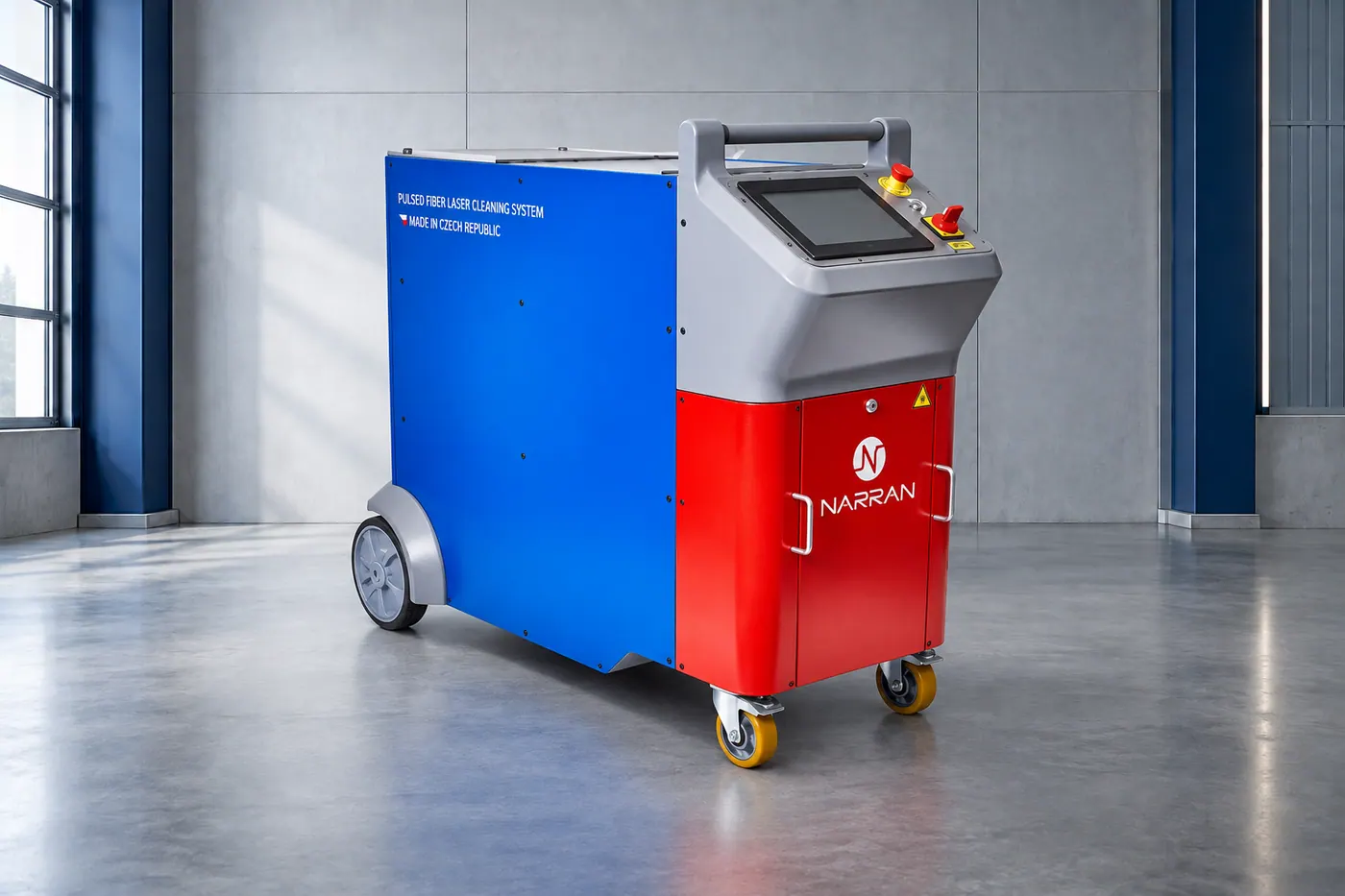
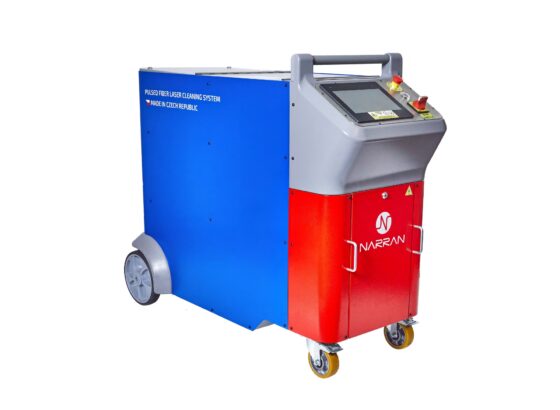
ROD 2000: a 2000 W laser cleaning machine in pulsed mode
ROD 2000 has the highest average power of the pulsed base models. According to the manufacturer it is water-cooled, weighs 250 kg, measures 140 × 64 × 112 cm and needs a 400 V three-phase supply (3 + N + PE, 50 Hz). The fibre is 10 m long, and the laser is Class 4. Housing, weight and connection match ROD 1000; only the power is twice as high. When buying a 2000 W laser cleaning machine, the technology at the installation site therefore matters less than the task that needs this much power.
When 2000 W is needed
Two cases point to this class: several square metres at a stretch, and thick or multi-layer coatings. A table from a manufacturer of pulsed fibre lasers shows how big the step can be. For stripping paint and powder coating it gives 4.4 to 8.4 m² per hour at 2000 W for 100 µm coating thickness, and 3.0 to 3.9 m² at 200 µm. At 1000 W the table gives 1.2 to 2.8 and 0.9 to 1.4 m². Between 500 and 2000 W this manufacturer’s figures rise by more than a factor of four, because its larger machines use a different laser type. The figures apply to its system and not to ROD 2000.
For individual spots and small parts, this class is more machine than you need. On very large areas blasting is faster, as laser manufacturers themselves write. The guide to laser cleaning versus sandblasting sets out the comparison.
Checking thick old coatings
Thick old coatings on large steel structures are one case for this class. Old paint can contain red lead, chromates, zinc or asbestos-bearing fillers, which are released as smoke and fine dust when removed. The DGUV advises having unknown coatings analysed before work starts; where nothing is known, the highest protective measures apply. Extraction, filters and protective equipment follow from the result of the analysis. Multi-layer coatings need several passes. The page on paint removal shows which coatings are documented.
ROD 2000 or DIVA 3000?
Both are water-cooled. ROD 2000 is pulsed, while DIVA 3000 is a continuous-wave laser with 3000 W. A continuous-wave laser heats the component far more. That argues for the pulsed laser on thin sheet or sensitive surfaces, and it can suit large, massive steel parts. The page on pulsed laser cleaners explains the difference.
Power supply and installation
The three-phase connection has to match the power consumption of the configuration quoted, which is given in the connection data sheet. A data sheet from another manufacturer lists about 7 kW for 1000 W of laser power; that cannot be scaled up to 2000 W. Allow for 250 kg and 140 × 64 × 112 cm in the route in and the floor space, plus room for extraction and shielding.
Questions about ROD 2000
How does ROD 2000 differ from ROD 1000?
According to the published data, only in average power: 2000 instead of 1000 W. Weight, dimensions, fibre length and mains connection are the same, says the manufacturer. What the higher power changes in the process depends on the task.
Does ROD 2000 run on 230 V?
No. According to the manufacturer it needs a 400 V three-phase supply. Get the connection data for the configuration quoted in writing before you fix the location.
Is there a Bright+ version of ROD 2000?
Yes, as a separate variant: ROD 2000 Bright+. The name alone does not establish technical differences, so compare the two versions against their documentation.