01LASER CLEANING MACHINE
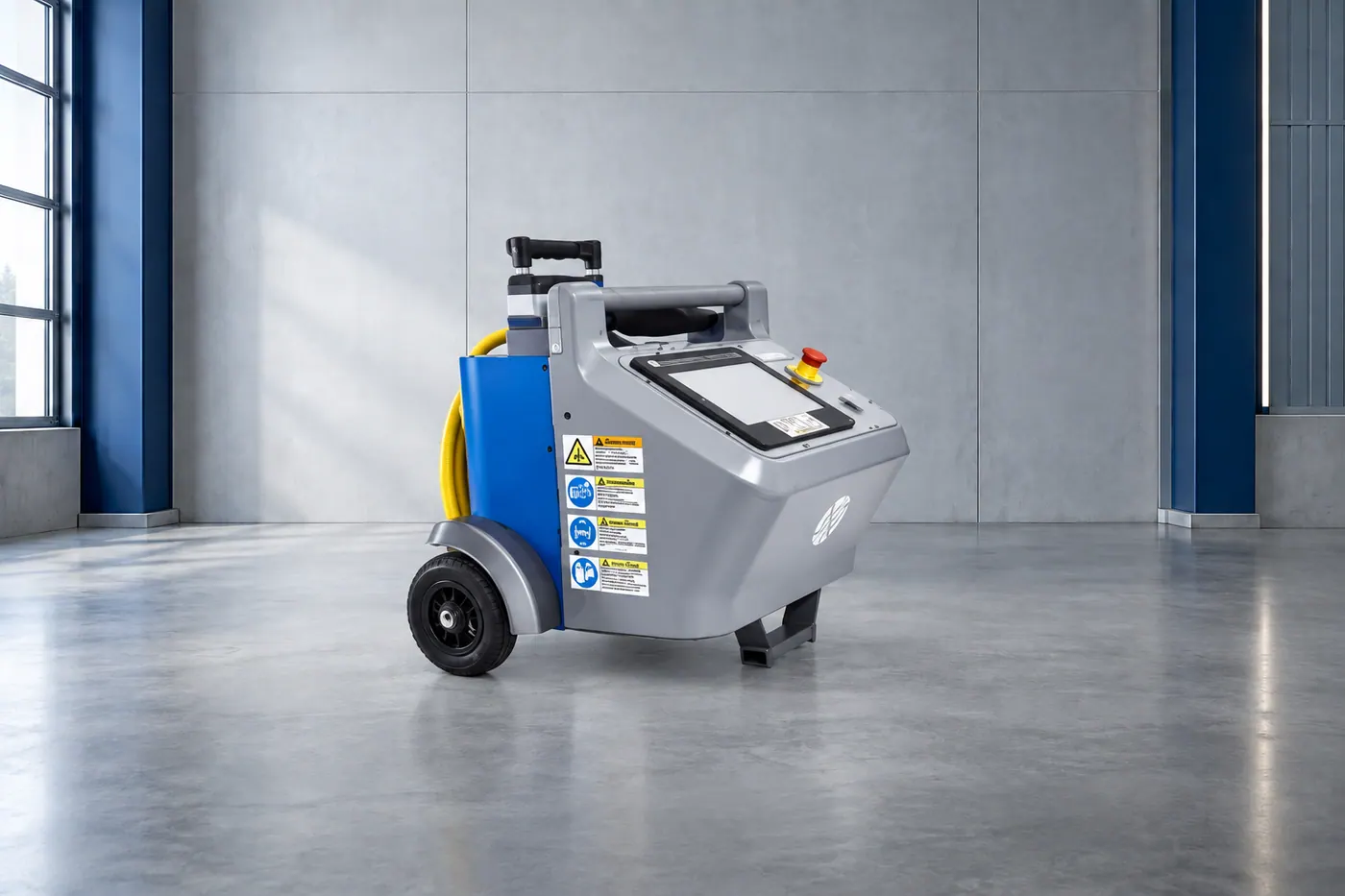
ROD 100 Air
100 W · pulsed · air-cooled
Assess ROD 100 Air against your components and required surface result.
INDUSTRIAL LASER CLEANING
Laser rust removers with 100 to 2000 W: models with manufacturer data, buying criteria and price factors. What matters is which rust layer has to come off which surface.
Request equipment adviceMODELS IN OUR RANGE
Three power classes to start from: an air-cooled 100 W machine and water-cooled machines with 500 W and 1000 W. Your enquiry establishes which configuration suits your rust removal task.
100 W · pulsed · air-cooled
Assess ROD 100 Air against your components and required surface result.
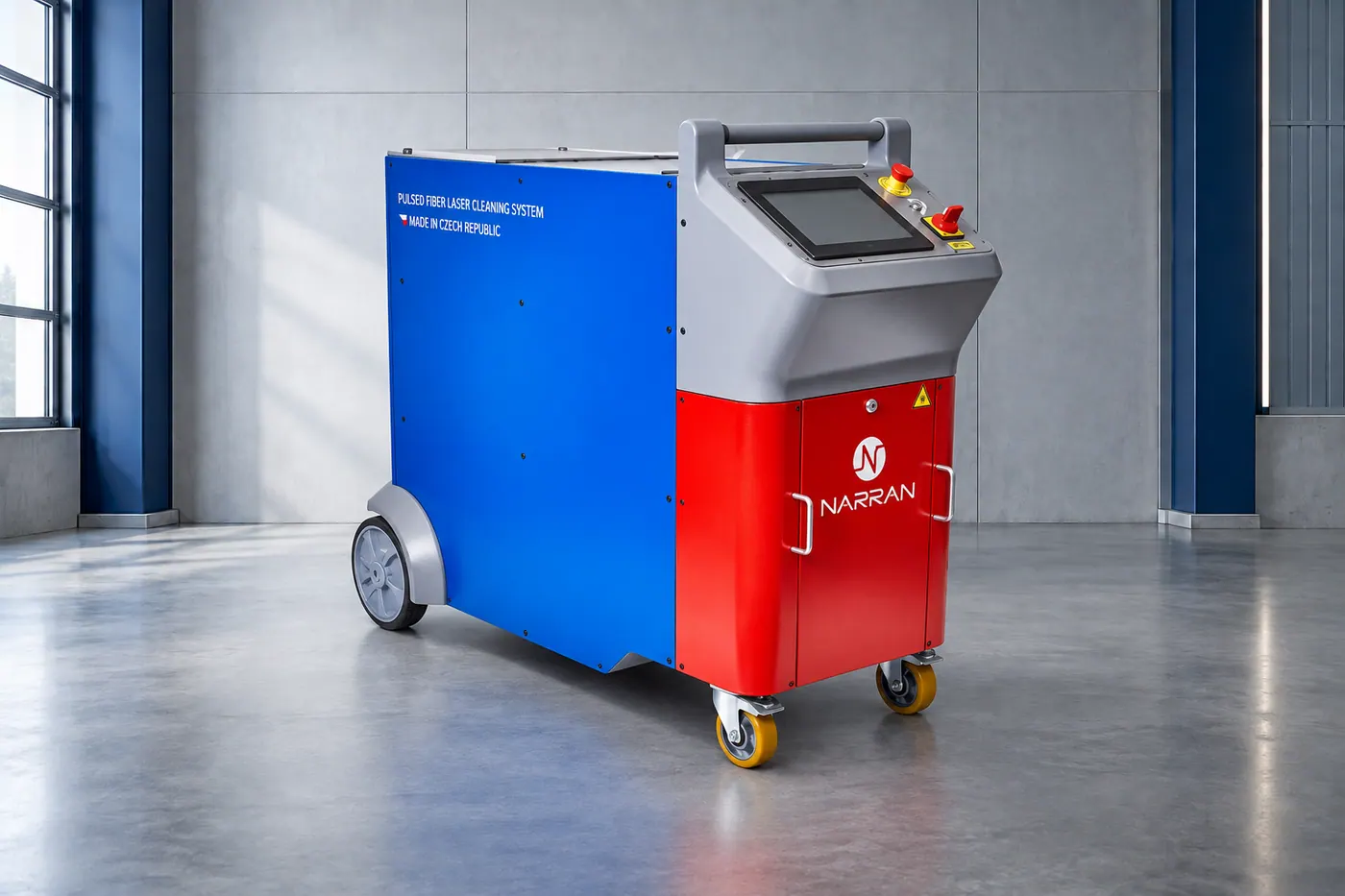
500 W · pulsed · water-cooled
Assess ROD 500 for your cleaning task and compare it with Bright+.
1000 W · pulsed · water-cooled
Assess ROD 1000 for your process and the next production step.
Data as published by the manufacturer, as of 23 September 2026. The quotation confirms the current configuration. Studio views are AI visualizations based on manufacturer images.
A laser rust remover is a laser cleaning machine selected and set up for rust. The same machines are also sold as rust lasers, laser rust cleaners, rust laser cleaning machines or simply laser cleaners. The pulsed models in the range run from 100 to 2000 W average power. The three machines above show the span from 100 to 1000 W.
ROD 100 Air is air-cooled, weighs 39 kg according to the manufacturer and is specified for 230 V. This class is an option for smaller areas and changing work locations. The manufacturer states that the smallest machines handle thick deposits very slowly or not at all. ROD 500 and ROD 1000 are water-cooled and weigh 240 and 250 kg. A 10 m fibre runs from the machine to the component. If you remove rust at changing locations, compare the weight and supply of the models on the handheld page.
For thick rust on large areas the range continues with ROD 2000 and the DIVA 3000 continuous-wave laser. A continuous-wave laser heats the component far more than a pulsed laser. That suits large, solid steel parts that shed heat quickly. For sensitive surfaces it is a reason to choose a pulsed machine. The pulsed laser cleaners page explains the difference.
| 100 WROD 100 Air | 300 to 500 WROD 300 Air, ROD 500 Air, ROD 500 | 1000 to 2000 WROD 1000, ROD 2000 | |
|---|---|---|---|
| Weight and cooling | fits well: 39 kg, air-cooled | fits well: 39 to 40 kg air-cooled, ROD 500 water-cooled at 240 kg | with limits: 250 kg, water-cooled |
| Power supply | fits well: 230 V | fits well: 230 V | with limits: three-phase 400 V |
| Fibre to the component | with limits: 5 m | fits well: 10 m | fits well: 10 m |
| Single spots, small parts | fits well: made for this | fits well: yes | with limits: more machine than needed |
| Several square metres in one go | poor fit: takes hours to days | with limits: feasible, see the calculator | fits well: made for this |
| Thick deposits | poor fit: not at all or very slowly, says the manufacturer | with limits: depends on the layer, clarify in a trial | fits well: a task for the kilowatt class |
fits wellwith limitspoor fit
The data on weight, cooling, supply and fibre come from the manufacturer. The assignment of tasks is a guide. Whether a class suits your component is shown by a trial on your rust layer.
The power class mainly decides the time. One maker of pulsed fibre lasers publishes how much area its lasers cover per hour, by laser power and by layer. The calculator turns that into a time for your area.
Manufacturer information, converted
Time for your area by laser power
Enter the area and choose the layer. The range shows how far the manufacturer's figures for the same power lie apart.
Example for 5 m²:
Rust, grade C
100 W3.6 h to 22 h
200 W1.3 h to 7.1 h
300 W1.1 h to 4.3 h
500 W56 min to 2.7 h
Mill scale
100 W24 h to 250 h
200 W11 h to 71 h
300 W7.1 h to 42 h
500 W4.3 h to 26 h
For 5 m² of grade C rust, a 100 W laser needs between three and a half and just under 22 hours according to this table. With 500 W it is between one and just under three hours. The range is wide. That is how the manufacturer states it, and it shows how much the result depends on the individual task.
If you select mill scale in the calculator, the times multiply. A pulsed laser does not remove tightly adhering scale economically. Under the US standard AMPP SP21511-1 of 2024 the laser may remove loose mill scale; tightly adhering scale has to be removed mechanically. The laser rust removal page shows how well each rust condition comes off, using the four rust grades.
On a vehicle the same rule applies: the laser cleans what the beam can see. For frames, axle parts and body panels it helps that a pulsed laser puts little heat into the metal and precisely hits only the strip it is moved across. On the underbody it reaches the open surfaces. It does not get into cavities or inside a tank.
Compared with sandblasting and a wire brush, a laser rust remover is a different tool. It works without abrasive and, with the right settings, leaves the metal in place, but on large areas it is slower than blasting. The guide laser cleaning vs sandblasting sets out the comparison.
A product name alone does not establish suitability. Describe light oxides, uneven corrosion or difficult access, together with the material and component geometry.
Identify any paint, oil or additional residues. A mixed surface should be described as such rather than treated as a rust-only application.
Maintenance and recoating can require different surface conditions. Agree on assessment criteria for the cleaned area, including any requirements from the next process. A clean-looking component does not answer every quality question.
Ask to see the EC declaration of conformity and the CE marking for the configuration you are offered. Both must be in place before the manufacturer places a machine on the market. Operating instructions belong to the delivery; for use in Germany, ask for the German version.
According to the manufacturer, the models in the range are class 4 lasers. In Germany the employer must appoint a laser safety officer in writing before a class 3R, 3B or 4 laser goes into operation, unless the employer has the required expertise. Work areas where exposure limits may be exceeded must be marked and cordoned off. The laser safety guide covers what this means for your site.
The removed rust leaves the surface as particles and fumes. Clarify whether extraction is part of the supply scope or whether you will use an existing system. Also ask who provides service in Germany and how spare and wear parts are supplied.
A laser rust remover needs electricity and filters for the extraction. It uses no abrasive, acid or water, and it leaves no spent abrasive to dispose of. According to one manufacturer’s figures, the power consumption ranges from 1.5 kW at 100 W to about 7 kW at 1000 W laser power, depending on the class. What your configuration draws is in the connection data sheet.
Working time comes on top, and it depends on the area rate. A business that removes rust only occasionally calculates differently from one with a daily need. The guide on renting or buying sets out the calculation.
The price depends first on the power class and the operating mode of the laser. Cooling, the processing head with its optics and the fibre length come next. Extraction, protective equipment, training and delivery may be added, depending on the quote.
We state prices in the quote, not on the website. The price factors page explains the cost blocks. In the enquiry form you choose a budget range.
Ask for the price of a laser rust remover
Rust condition, material and area are enough to start. The price is stated in the quote for a suitable power class.
Record typical part dimensions, workload and access. Explain whether the same area is cleaned repeatedly or component shape and position change. See maintenance for the working context.
Our buying guide connects these requirements with equipment selection. Your request should describe the task rather than choose a machine from one specification.
YOUR NEXT STEP TOWARDS EQUIPMENT
Describe your application and intended use to prepare equipment selection.