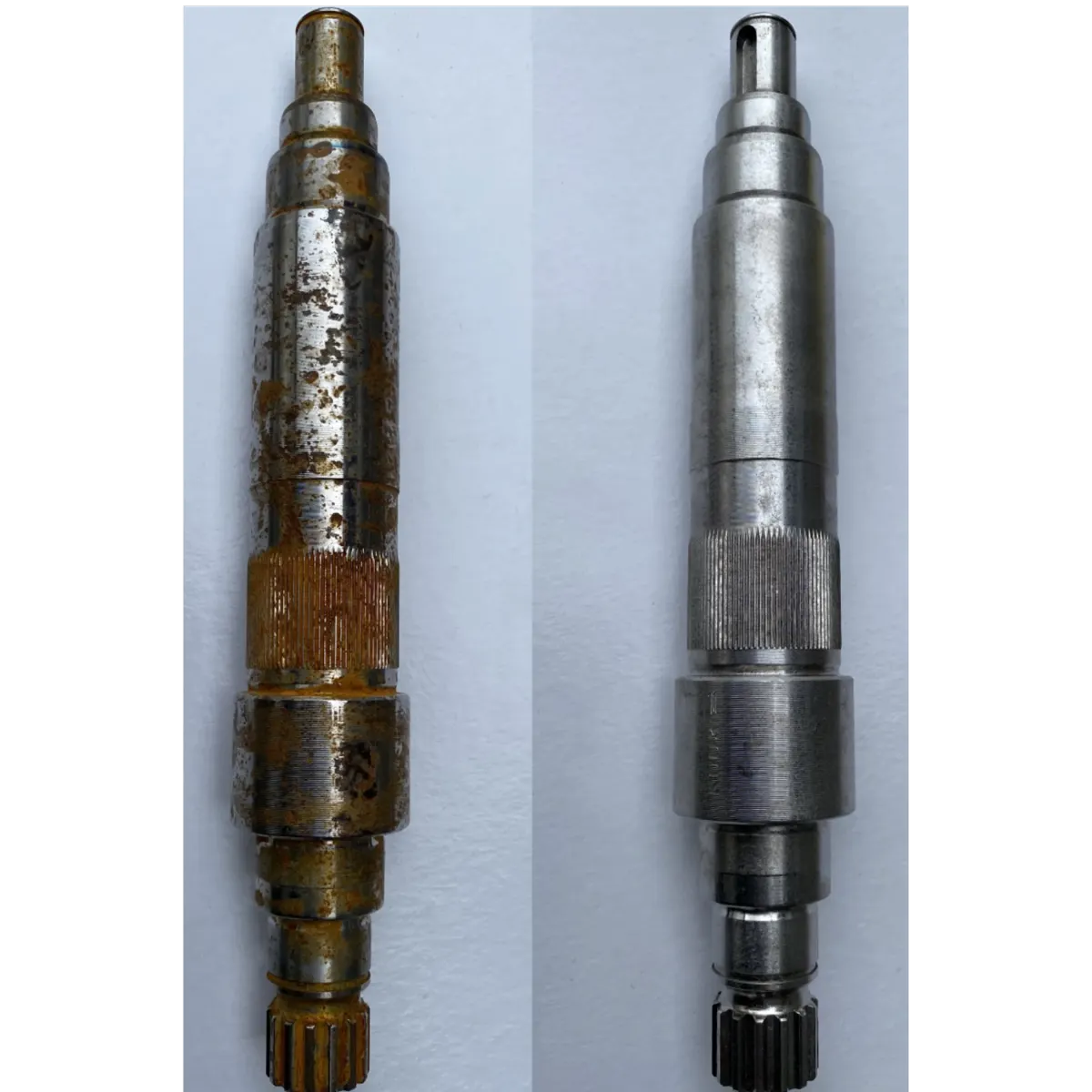
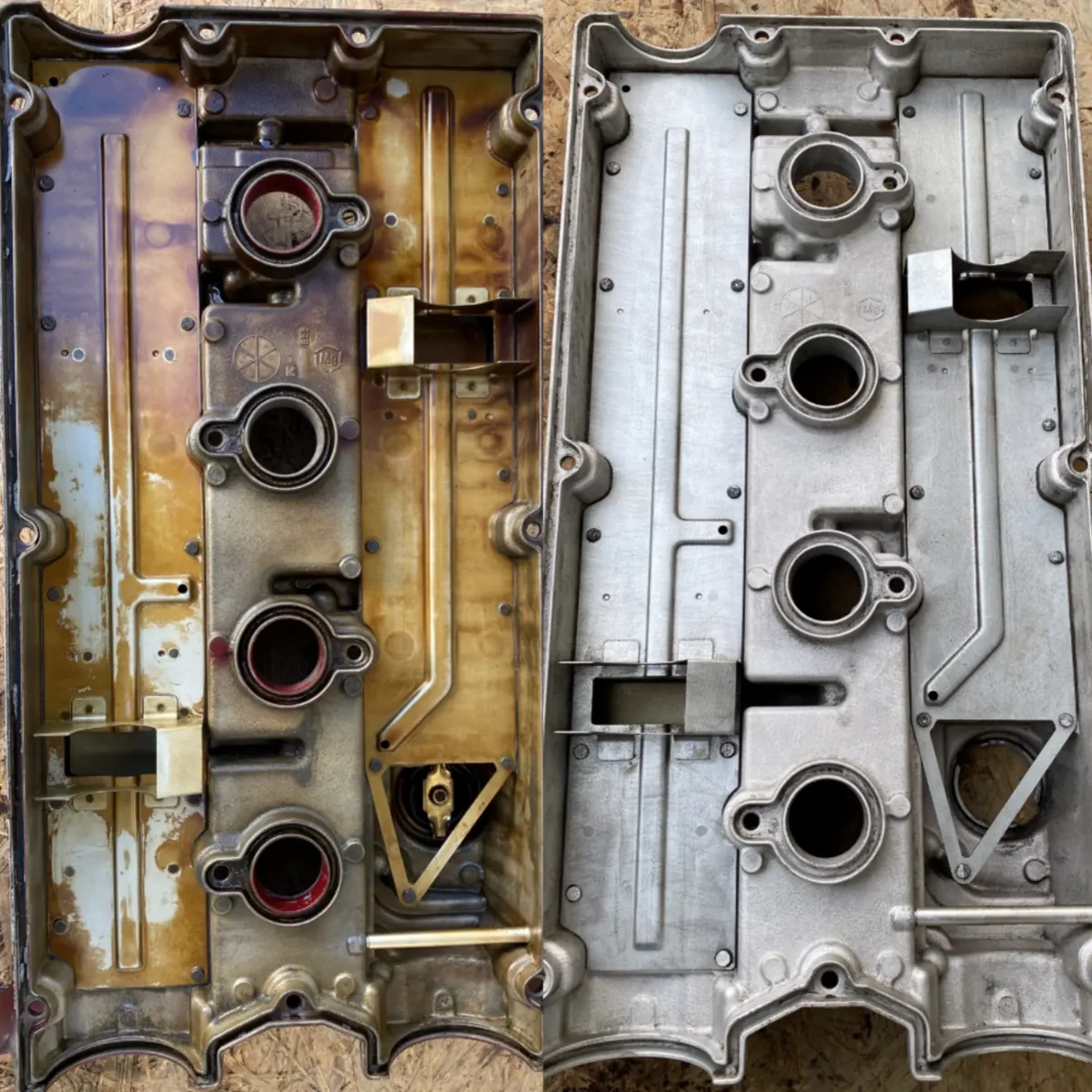
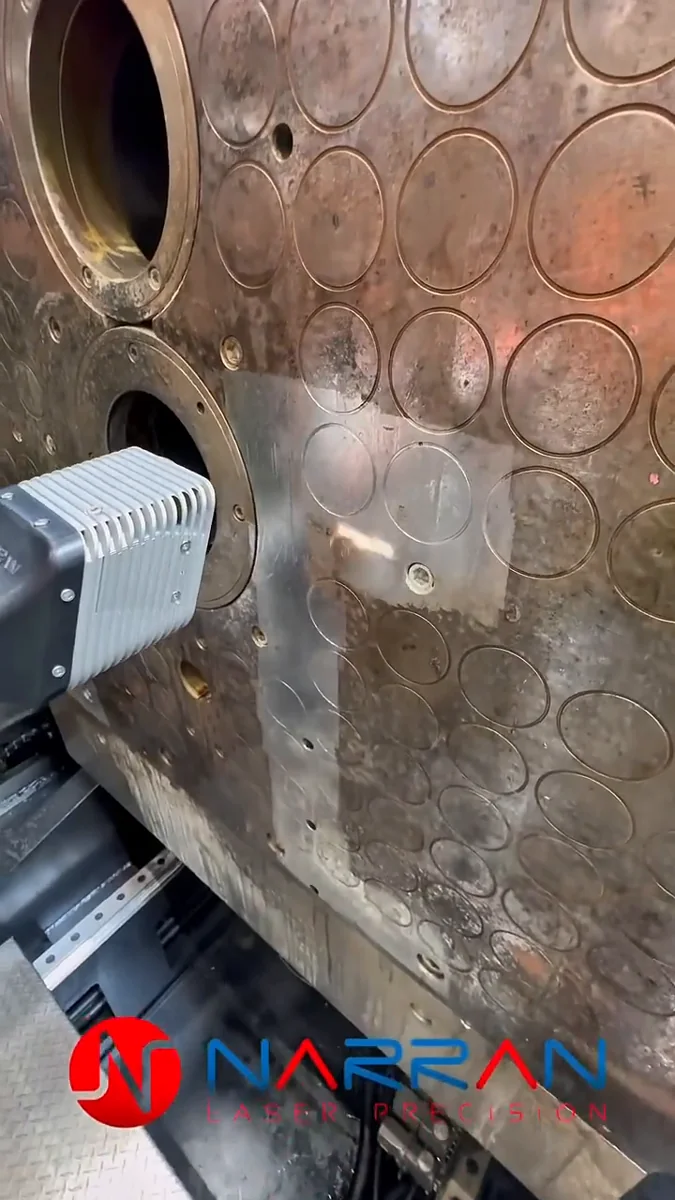
How a laser removes rust
The processing head moves the laser beam across the part as a narrow line. Each pulse hits the rust layer at very high intensity, but only for an instant. The layer turns the light into heat and evaporates abruptly. A plasma forms and supports the removal. That is how the Fraunhofer Cleaning Technology Alliance describes it, and it also names the reason the substrate survives: the very short interaction time.
The process ends at the metal because the two materials have different thresholds. Rust is removed at an energy density that cannot yet harm the steel. With the pulses set correctly, they are enough for the rust layer and not for the metal underneath. Fraunhofer ILT calls a process like this self-limiting and says it can usually be achieved on metal.
No forces and no media act on the part. Nothing is blasted, brushed or pickled, no chemicals are needed, and a bright metal surface is left. The laser is also precise: it only hits the strip it is moved across. The rust itself does not vanish: it rises as fume and dust and belongs in an extraction unit. The guide How laser cleaning works explains the process in detail.
Which rust a laser can remove
The word rust covers very different conditions. ISO 8501-1 distinguishes four rust grades, from almost intact mill scale to a pitted surface. For a laser this is more than a formality, because it behaves differently on each of them. In the graphic, pick the condition closest to your part.
Rust grades to ISO 8501-1
Four starting conditions, four different jobs
Rust grade A
- What you see
- The surface is largely covered with firmly adhering mill scale, the blue-grey skin from the rolling mill. Hardly any rust is visible.
- What the laser can do
- Firmly adhering mill scale is not a worthwhile target for pulsed lasers. It is removed by blasting or mechanically.
- What else it takes
- For structural steel with mill scale, blasting is regarded as the most economical method.
Rust grade B
- What you see
- The steel has begun to rust and the mill scale has begun to flake.
- What the laser can do
- Rust and loose mill scale can be removed. Mill scale that still adheres firmly remains a job for mechanical methods.
- What else it takes
- After the first pass, check whether dark islands of mill scale are left.
Rust grade C
- What you see
- The mill scale has rusted away or can be scraped off. A few rust pits are visible to the naked eye.
- What the laser can do
- The typical case for the laser: the rust layer comes off, the metal turns bright and shallow pits become visible.
- What else it takes
- Bare steel rusts again. Plan primer or oil straight afterwards.
Rust grade D
- What you see
- The mill scale has rusted away. Numerous rust pits are visible to the naked eye.
- What the laser can do
- The rust is removed, the pits stay. The laser does not replace metal.
- What else it takes
- Whether the wall thickness is still sufficient only shows on the bare part. Knock off thick, flaky layers mechanically first.
Two things stand out. The first is mill scale. A pulsed laser does not remove firmly adhering mill scale economically. The US standard for laser preparation of steel published in 2024 (AMPP SP21511-1) says so explicitly: the laser may remove loose mill scale, while tightly adhered scale has to be removed mechanically.
The second is pitting. The laser takes the rust out of the pit but does not fill it. If you laser a badly pitted part, you see afterwards how much material is really missing. That is useful to know, even when it is unwelcome.
Uneven rust often needs two passes. In a study on structural steel, a rust layer of varying thickness could hardly be controlled with one setting. The surface only came clean with one pass at high power and a second at low power.
What happens to the surface
In the right range the steel stays grey and bright. That changes as the energy density rises. A study published in 2026 with a pulsed fibre laser (1064 nm, 100 ns) shows the sequence on an alloy steel: at 5.10 J/cm² the oxide layer was not yet fully removed, at 7.64 J/cm² the metal was exposed and slightly yellow, and at 10.19 J/cm² the surface melted in places and oxidised again, visible as darker, brown regions. The figures apply to that steel and that laser. What carries over is the sequence: too little, right, too much.
Too much energy also comes from moving too slowly. If the beam stays on bare metal for longer, the steel takes up more heat, discolours and in the worst case begins to melt. With a handheld machine you therefore keep the head moving and go over a spot twice quickly rather than once slowly.
Stainless steel needs particular care with the settings. After cleaning 304L with a kilowatt-class nanosecond laser, researchers found a chromium-rich oxide layer a few micrometres thick with a chromium-depleted zone beneath it. If you remove rust from stainless steel, have the corrosion resistance checked afterwards.
Laser, blasting, brush or acid: what is enough for what
Not every kind of rust needs a laser. Garden shears need a bath in vinegar or citric acid, a railing needs a wire brush, a steel beam needs a blasting unit. The table shows where each method is strong.
| Laserpulsed, handheld | Blastingwith solid abrasive | Brush, grinderby hand or power tool | Acid, rust converterbath or applied | |
|---|---|---|---|---|
| Loose rust on a small area | suitable with limits: works, but is often more technology than needed | suitable with limits: rarely worth the set-up | well suited: usually enough | well suited: immersion bath for small parts |
| Firmly adhering mill scale | unsuitable or laborious: not economical | well suited: standard method | unsuitable or laborious: removes loose scale only | well suited: pickling is common for this |
| Large areas | suitable with limits: slower than blasting | well suited: fastest method | unsuitable or laborious: too slow | suitable with limits: only possible in a bath |
| Moulds, fits, threads | well suited: no removal of base metal | unsuitable or laborious: roughens; threads and sealing faces must be masked | suitable with limits: leaves score marks | suitable with limits: pickling risks hydrogen embrittlement |
| Roughness for a coating | suitable with limits: creates no blast profile; roughening is a separate, slow step | well suited: gives roughly 40 to 80 µm peak-to-valley height | suitable with limits: only for surface-tolerant primers | unsuitable or laborious: no roughness |
| What is left over | well suited: the removed rust in the filter | unsuitable or laborious: debris of abrasive, rust and old paint | suitable with limits: dust | unsuitable or laborious: spent acid and rinse water |
well suitedsuitable with limitsunsuitable or laborious
Household remedies work through their acid; in cola it is phosphoric acid. The part sits in the bath, is then rinsed thoroughly and dried at once, otherwise acid residues attack the metal again. Rust converters also mostly work with phosphoric acid or with tannin. They do not turn rust back into metal but into a dark grey to black layer that can be painted over.
The laser is strongest where the part itself must not be affected or where abrasive gets in the way: on moulds, on mating surfaces, on single spots of an assembled machine, on the joint before welding. The guide Laser cleaning vs sandblasting compares the two methods in detail.
How fast a laser removes rust
There are no research measurements in square metres per hour for this. What exists are guide values from manufacturers of other systems. They show the order of magnitude and above all two dependencies: on laser power and on what sits on the steel.
Manufacturer figures, converted
Area rate by laser power: rust and mill scale
100 W
200 W
300 W
500 W
By these figures, mill scale comes off about ten times more slowly than rust. That matches what the standard says. A second manufacturer quotes 5 to 10 m² per hour for light oxide layers with a 500 W system, and a third puts the gap between light and heavy rust at a factor of ten.
Values like these depend on rust thickness, material, geometry and settings. They cannot be transferred to another machine. On very large areas blasting is faster, and laser manufacturers say so themselves. The page laser rust removers shows which power classes are in our range.
What comes after rust removal
Bare steel rusts again. Indoors, iron starts to rust at about 65% relative humidity, and at lower values if salt or dust sits on the surface. In heavy-duty corrosion protection the rule is therefore: the first coat immediately after preparation, at no more than 60% humidity and with the part at least 3 K above the dew point.
No standard gives a window in hours. Individual specifications demand priming within 4, 8 or 24 hours after blasting. There is no separate rule for laser-cleaned steel. Treat it like freshly blasted steel.
Does a coating hold on laser-cleaned steel? Fraunhofer IFAM examined this in the research project LaserRep, which ended in mid-2024. After salt spray testing and outdoor exposure on the island of Helgoland, laser-cleaned samples showed at most 1.5 mm of underrusting, the conventionally prepared reference samples 18 mm. In the project the surface was also roughened by laser, and that step takes time: according to the report it cannot yet match the speed of automated blasting processes.
Where rust is removed by laser today
Before welding. Rust and oil at the joint disturb the seam. The laser cleans exactly the strip that will be joined, and in laser welding cells it can even use the same beam source.
In moulds and tools. What counts here is that the contour stays as it is. The footage at the top of this page shows such a mould.
In steel construction repairs. Where a coating is renewed only in places, the laser prepares the spot without an enclosure for abrasive.
On vehicles. With frames, axle parts and body panels, what counts is that little heat gets into the sheet. That speaks for a pulsed laser and a brisk hand. Expect rust removal on a car to reveal spots that were already rusted through underneath.
In shipbuilding. The US Navy is testing the process on board. In a trial on the aircraft carrier USS Ronald Reagan, hearing protection was required only within 5 feet of the laser, about 1.5 m. For the needle gun it was 95 feet, just under 30 m.
Safety: laser class 4 and old paint under the rust
Cleaning lasers are class 4 lasers. Operating one in Germany requires a demarcated laser area, protective eyewear and a laser safety officer appointed in writing (section 5 OStrV). Rust removal often adds a second topic, because old corrosion protection frequently sits under the rust. Red lead was a widespread anti-rust paint, and when it is removed the lead ends up in the fume.
The German accident insurers (DGUV) therefore advise having unknown coatings analysed before work starts and require effective extraction as close to the source as possible. The guide Laser safety for laser cleaning explains what the business has to organise.
What belongs in the equipment enquiry
Five details matter for choosing the machine: the material, the rust condition (two photos are the easiest way), the area per job or per week, what happens to the part after rust removal, and where the work takes place. If you do not know what sits under the rust, write exactly that. An open question helps more than a guess.
What does a laser for your rust task cost?
These five details are enough to narrow down the power class. The price is stated in the quote.
Laserkompass prepares the purchase of your own machine. We do not remove rust as a service. If you only remove rust occasionally, the guides section has the calculation for renting or buying.