Why molds are a case for the laser
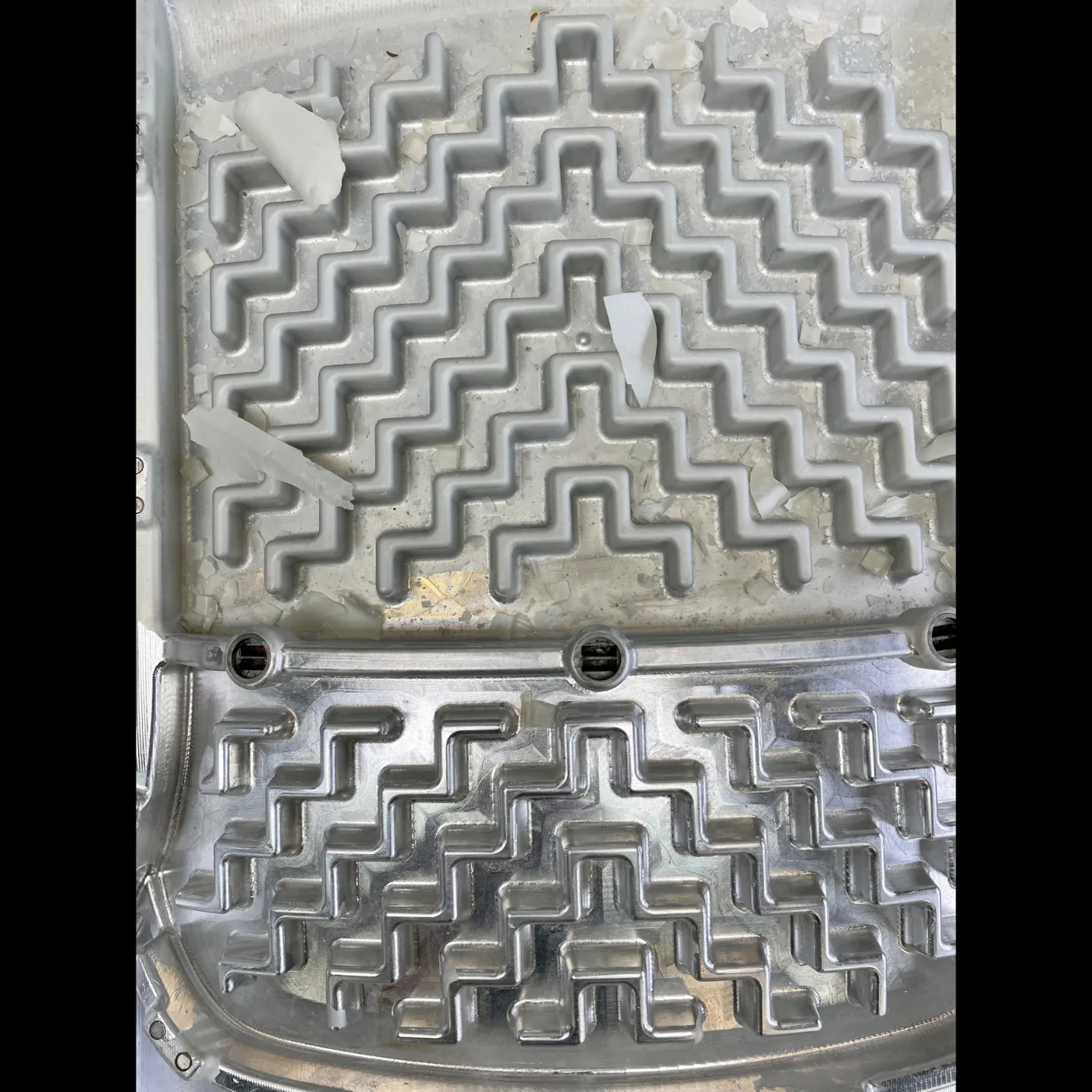
Something is left behind in every mold: product residue, release agents and, with plastics, deposits that come from the material itself. They have to come off regularly, and the mold is supposed to stay as it is. That is where the classic methods fail. Blasting rounds off fine engravings, the abrasive clogs the vents, and the removal wears the mold. According to one manufacturer, molds with spring vents must not be blasted at all.
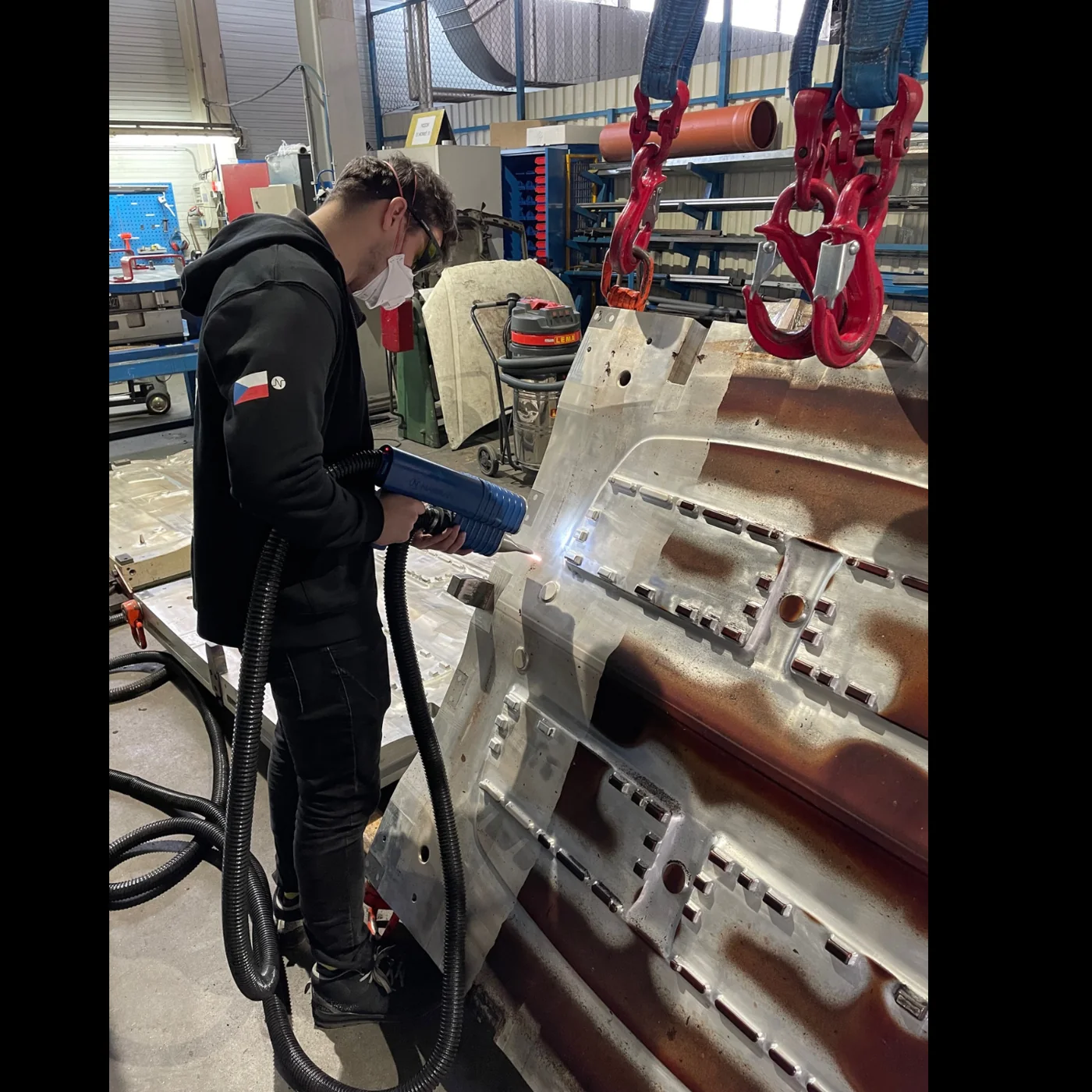
The laser takes off the deposit and leaves the metal in place. One manufacturer reports elastomer molds on which neither edge erosion nor mechanical removal is found even after several thousand cleaning cycles. For the service life of a tool, that is what counts. Then there is time: the mold can stay hot and installed, and cooling, removal and reheating are no longer needed.
The article How does laser cleaning work? explains the removal. This page deals with the molds for which the process is documented and with where it can harm the mold.
Which molds are cleaned with the laser
The evidence comes mainly from the makers of the systems. Select a mold type:
Mold types
What is documented for which mold
TyresTyre molds. The best-documented example. Two manufacturers give 30 to 60 and 25 to 75 minutes per mold. Cleaning is hand-guided in the press or automatic on the removed mold. Molds with micro vents are not damaged.
RubberElastomer molds. Molds for parts made of EPDM, NBR or natural rubber are freed of release-agent residue and cracked elastomer residue, also hot and installed.
InjectionInjection and compression molds. One manufacturer lists them for its mobile system, including cleaning in the press. We found no documented case with cycle data. Aged deposits are much harder to remove than fresh ones.
CFRPComposite molds. According to a manufacturer, molds of nickel, steel, aluminium and Invar are cleaned without damage, automated at clearly above 20 m² per hour.
BakingWafer and baking molds. Cleaning is offline or in the hot oven at over 200 °C, without interrupting production. The surface must be metal. With powdery and thick residues the process reaches its limits.
Tyre molds are the best-documented case. One German manufacturer writes that its automatic cell is installed at the ten largest tyre makers. The mold stays in its container, each mold has a taught program, and the closed cell is built as laser class 1. According to the manufacturer the noise is below 78 dB(A).
For injection molding the evidence is thinner. Fraunhofer IFAM describes where the deposits come from: mostly from the plastic itself. Light compounds block the vents first, heavy ones form a film in the cavity. Cleaning is mostly manual. As dry processes the institute names CO₂ snow blasting and laser systems; it gives no figures for the laser.
Laser, dry ice or blasting
The obvious alternative is dry ice. It also cleans the hot mold in the press, and the German accident insurers explicitly list it for molds in casting processes, hot-forming dies and press molds.
| Laserpulsed | Dry icepellets and compressed air | Blastingsolid abrasive | |
|---|---|---|---|
| Contour and engraving | in favour: no removal of mold material | in favour: widely used for molds | against: rounds engravings, wears the mold |
| Vents | in favour: stay clear | with limits: dirt can get into valve openings | against: abrasive clogs them |
| Cleaning hot and installed | in favour: yes | in favour: yes | against: mold is removed |
| Noise | in favour: usually below 80 dB(A) | against: 75 to 125 dB(A) | against: noise and dust need an enclosure |
| What is consumed | in favour: electricity, filters | with limits: dry ice, compressed air | with limits: abrasive, compressed air |
| What is left over | in favour: the residues in the filter | with limits: dirt spreads as dust | against: abrasive with residues |
in favourwith limitsagainst
Two notes on the table. The statements about dry ice in the vents row and in the last row come from a laser manufacturer, that is, from a competitor of the process. And the dry-ice side has figures of its own: a maker of dry-ice equipment writes that cleaning hot sidewalls in the press takes 11 minutes, while the conventional cycle of cooling, removal, cleaning and reheating takes about 13 hours.
That leaves the bath. For rubber curing dies, hot alkaline immersion with brushing is widely used. In the long run, according to a research paper, it leads to die failure through corrosion and mechanical damage. For conventional cleaning, injection molds are often disassembled completely, with long downtime and heavy solvent use.
Where the laser can harm the mold
One manufacturer names the limits of its process itself. It cannot be used on strongly undercut contours and is not possible in very deep, thin bores. Electroformed nickel molds and high-gloss polished molds tend to change gloss after laser treatment. Thick local build-up such as lumps of rubber or plastic comes off only inefficiently.
| Mold surface | What is documented |
|---|---|
| Steel, aluminium, Invar | cleaned without damage (manufacturer information) |
| High-gloss polished | gloss can change |
| Electroformed nickel | gloss can change |
| Chrome-plated | cleaned at 0.97 J/cm²; cracks in the chromium layer above 10.2 J/cm² |
| Stainless steel, cleaning at kilowatt level | oxide layer and chromium-depleted zone possible |
With chrome-plated molds the window is narrow. In one study a 100 W laser cleaned rubber residue in a single pass, with a defocused beam and 0.97 J/cm² per pulse. A second paper found cracks in the chromium layer above 10.2 J/cm², and also when more than three pulses hit the same spot. In slots, the threshold at which thick rubber comes off completely can even lie above the damage threshold of the mold.
We found no figures on gloss or roughness change on polished, textured or coated tool steels. If your mold has a grain, a high gloss or a PVD layer, insist on a trial on a sample part or a retired mold.
What is cleaned is the metal mold, not the plastic part. For plastics and rubber themselves, laser cleaning at 1064 nm is rarely suitable, according to one manufacturer.
Which power, which design
Molds are cleaned with pulsed lasers in the nanosecond range. In the two studies on chrome-plated molds these were 100 W and 500 W. One system maker lists mobile systems up to 1 kW. Power mainly determines the time per mold and says little about whether the surface stays unchanged. That is decided by the fluence.
There are two routes for the design. If you clean in the press, you work with a handheld machine and therefore with an open class 4 laser. The working area, eyewear and extraction are part of it, as described in the article on laser safety. If you clean removed molds in a constant sequence, a closed cell is worth considering; the page on automated laser cleaning lists what has to be clarified.
What belongs in the equipment enquiry
Identify the mold material, surface treatment and residues as precisely as possible. Deposits from injection molding, rubber processing or die casting are not a uniform cleaning task. Describe release agents, coatings and known ingredients too, and record whether the tool will be removed or cleaned in place.
Define inspection criteria for the cleaned mold: remaining deposits, condition of sensitive contours and function after cleaning. A visually clean surface does not prove suitability for production.
What does a laser for mold cleaning cost?
State the mold material, the residues and the cleaning interval. The price is stated in the quote.
Tools used in food processes have their own hygiene and material requirements. This page promises neither sterilisation nor approval for food contact. In industrial maintenance, also consider the effort for removal, set-up and restart.