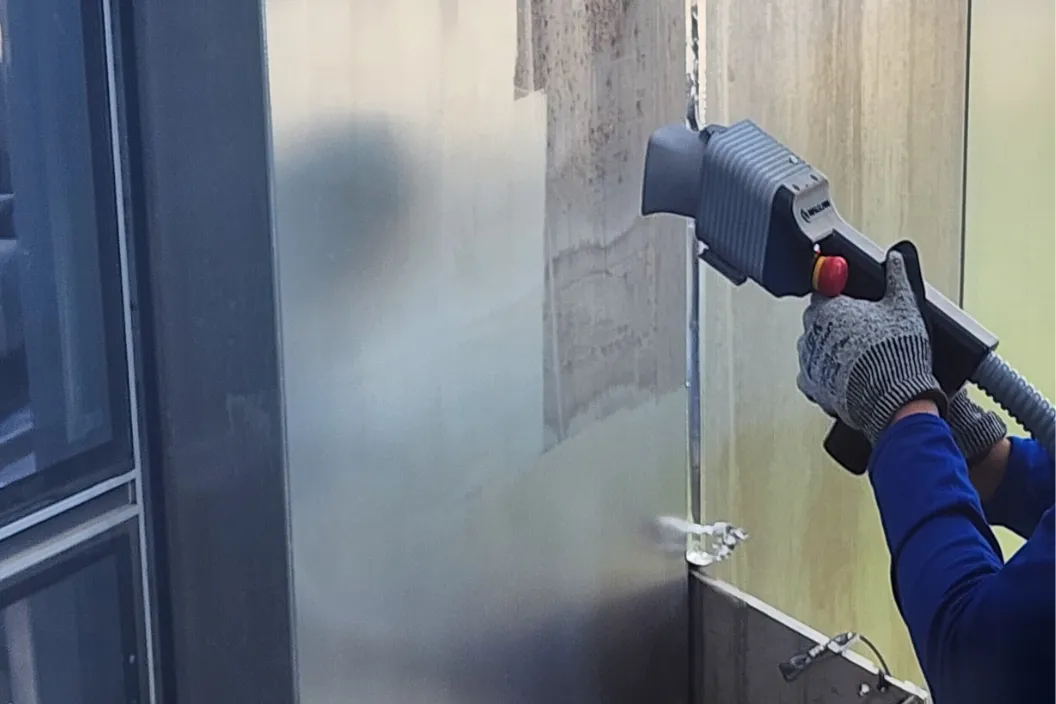
Mobile laser cleaning: what “handheld” means
In laser cleaning, the part you hold is the processing head. The laser source and cooling sit in the machine beside you, and a fibre connects the two. Three values matter for mobile use: machine weight, fibre length and power supply.
The same type of machine is also sold as a portable laser cleaner, a handheld laser cleaning machine or a laser rust removal gun. What you carry is the processing head, not the machine.
With a handheld machine you remove rust, paint, oil and other contaminants from metal surfaces. How precisely and how fast depends on the laser power in watts and on the settings. The applications are described on the rust removal and paint removal pages.
The air-cooled models are the lightest. ROD 100 Air and ROD 300 Air weigh 39 kg according to the manufacturer, ROD 500 Air 40 kg. All three are specified for 230 V. The fibre is 5 m long on ROD 100 Air and 10 m on the two larger models. The water-cooled ROD models weigh 240 to 250 kg and also have a 10 m fibre.
Fibre length is not the free working radius. Routing and bend radius limit how far the head can work from the machine. The weight of the processing head is a separate value; ask for it for the configuration you are offered.
The processing head: what to look for
The head decides how safe and how comfortable the work is. The German accident insurers describe what a hand-guided laser machine should have, and BG ETEM has turned that into a checklist for buyers. The diagram shows the seven points to ask about.
Diagram
Seven points on the head and the machine
The caution has a reason. BG ETEM wrote in 2024 that not all hand-held laser machines on the market meet the standards and the law, and that necessary safety devices are often missing. The design has its own standard, EN ISO 11553-2. In Germany the 2009 edition is in force. According to one manufacturer the international version was republished in August 2026; a German edition of the new version was not yet available at the beginning of October 2026. Ask which edition the quoted machine was assessed against.
For ergonomics, weight and posture count. The DGUV points out that posture and the weight of the head can cause increased strain, and that hand-held devices can fall. One published data sheet gives less than 5 kg for a handpiece. Anyone who will work overhead or in a constrained posture should have held the head before buying.
Line width and working distance
The head emits a line, not a spot. A scanner in the head places the pulses close together; to the eye this is a continuous laser line several centimetres long, which the operator moves across the surface. One buyer’s guide gives an adjustable scan width of 10 to 100 mm as an example. A wide line covers more area but spreads the same energy over more material.
The working distance depends on the optics. Published values range from 130 mm for short hand optics to half a metre. A larger distance protects the optics from debris. The beam needs a clear view of the surface: it does not reach what lies behind an edge.
For the quoted configuration, ask for the line width, the working distance and the weight of the head. These values are not on this website because they depend on the optics chosen.
Does handheld operation suit the component?
Handheld equipment may be considered for different parts or changing cleaning areas. Describe actual working positions: freely accessible surfaces, installed components and restricted movement can require different handling.
Consider moving the machine, preparing the working area, cleaning and relocating afterwards. A short demonstration alone does not represent the complete working day. If several people will use the machine, training and consistent procedures belong in the plan.
If the same part is always cleaned in the same place, it is worth looking at automated laser cleaning.
Working on the move: what changes at every location
A class 4 laser brings its laser area with it. In your own workshop it is set up once. If you take the machine to changing locations, you set it up again each time. For portable machines BG ETEM requires variable screens and warning lights at the entrances. At medium power, according to the DGUV, laser protection curtains or hardly flammable sheet-metal walls can be sufficient; in any case they should be tested. Screens shield only to the side. Upwards, and on scaffolding downwards too, further measures are needed.
At a customer’s premises, coordination is added. Whatever your own risk assessment does not cover has to be recorded and assessed additionally before work starts at that workplace. For several sites, several laser safety officers may be needed. These are German rules; other countries have their own.
Before working at a new location
Checklist for mobile use
Twelve points for work away from the fixed laser workplace. The list is a working aid and does not replace a risk assessment.
0 of 12 points settled
Everything else on the laser area, eyewear and the laser safety officer is in the article Laser safety in laser cleaning.
Backpack lasers and other designs
Anyone searching for a backpack laser cleaner will find it in the smallest power class. One German manufacturer lists such a unit with 20 W, a fibre of about 2 m and a working distance of up to 250 mm. For comparison: according to manufacturer figures, even a 100 W laser covers only 0.2 to 1.4 m² of rust per hour.
There is no backpack unit in our range. The air-cooled models stand next to the operator and reach the component through the fibre. The water-cooled machines weigh 240 to 250 kg; with them too, the operator guides the head by hand.
Handheld laser cleaner: what drives the price
The price of a mobile laser cleaner depends on power class, cooling and fibre length, plus the processing head with its optics. Accessories such as extraction and protective equipment for changing work locations are separate items and belong in any comparison of quotes.
Prices are stated in the quote. The price factors page shows which cost blocks to plan for besides the machine. We do not offer on-site cleaning; this page is about buying your own equipment.
What does a mobile laser cleaner cost?
The price depends on power, cooling and supply scope and is stated in the quote. Describe the component and where the machine will be used.
Describe where and how you intend to work in your equipment request, so handling, accessories and the working area can be assessed together.