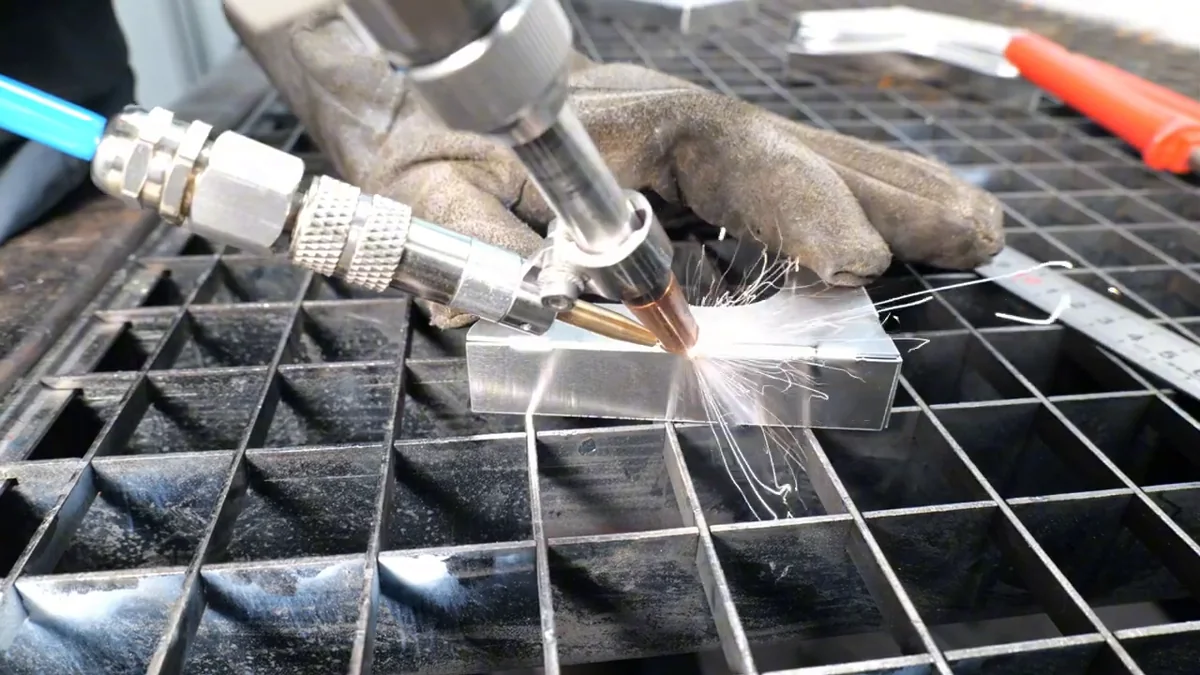
What heat tint is and why it matters
Next to a weld on stainless steel the metal turns yellow, brown or blue. These heat tints are oxide layers. They form when heat and oxygen act on the surface together. The passive layer that normally protects the steel changes in thickness and structure and can grow to as much as 300 nm. It then no longer protects reliably.
The reason lies beneath the colour. Chromium migrates into the oxide layer and leaves a chromium-depleted zone below. A new passive layer forms only on a bright metallic surface with full chromium content. Scale, heat tint and chromium-depleted areas prevent that locally, writes the German stainless steel association. So both the colour and the depleted layer underneath have to go.
The colour tells you roughly how hot the spot was. Select a shade:
Heat tint on 1.4301 (304)
Which colour forms at which temperature
Pale yellow, about 290 °C. In the range up to 400 °C, resistance to pitting corrosion is hardly affected, according to measurements by an industrial gas supplier. Whether the colour may stay is decided by the customer requirement.
Straw yellow, about 340 °C. For building applications the German stainless steel association requires straw yellow and lighter shades to be removed too. Other sources regard yellow as tolerable in most cases.
Dark yellow, about 370 °C. Still in the range where the measurements show little effect. For food and pharmaceutical equipment the usual rule is no heat tint at all, including this one.
Brown, about 390 °C. The boundary. From about 400 °C begins the range in which the pitting potential drops sharply according to the measurements. Remove.
Purple brown, about 420 °C. Between 400 and 800 °C the pitting potential drops dramatically according to the measurements, to the same low value for three steels tested. Remove.
Dark purple, about 450 °C. As with purple brown: the oxide layer no longer protects, and a chromium-depleted zone lies beneath. Colour and zone have to go.
Blue, about 540 °C. A distinct oxide layer. Where demands are high, brushing alone is not enough; the association leaflet then calls for additional pickling.
Dark blue, about 600 °C. The thickest layer on the scale. With strong heat tint and scale, pickling cannot be avoided according to the leaflet.
Does all heat tint have to go?
The sources do not agree. An industrial gas supplier measured the pitting potential of three stainless steels. With yellow heat tint it was hardly affected; with red to red-brown tint it dropped dramatically. Its conclusion: yellow can stay in most cases, the lighter the better.
For building applications the German stainless steel association is stricter. According to its 2024 leaflet all heat tint should be removed, including straw yellow and lighter. Where that is impossible, the weld should close the area completely. Food and pharmaceutical equipment usually demands complete freedom from heat tint.
In practice this means: agree with the customer which condition will be accepted before deciding on the method. The best heat tint is the one that never forms. With root shielding gas and less than about 50 ppm residual oxygen, only weak discolouration is to be expected.
Pickling, electrolytic cleaning, brushing or laser
The German leaflet on welding stainless steel names five ways of cleaning a weld: brushing, grinding, polishing, blasting and pickling. The laser is not among them. It was compared in 2019 in a degree project at KTH Royal Institute of Technology in Stockholm, supervised by the research institute Swerim: laser, electrolytic cleaning and pickling on the same welds.
| Laserpulsed | Picklingpaste or bath | Electrolyticelectrolyte and current | Brushing, grindingmechanical | |
|---|---|---|---|---|
| Time per specimen in the test | in favour: about 15 seconds | against: about 5 hours | with limits: 5 to 10 minutes | with limits: not measured |
| Corrosion resistance afterwards | with limits: improved in the test, but not fully passive | in favour: regarded as the benchmark | in favour: passive next to the weld in the test | with limits: pickle afterwards where demands are high |
| Hazardous substances | in favour: no chemicals, extract the fume | against: hydrofluoric and nitric acid | with limits: weaker electrolytes | in favour: none |
| Waste water and waste | in favour: filter dust | against: collect and treat rinse water | with limits: less strict disposal | in favour: grinding dust |
| Strong heat tint, scale | with limits: clarify in a trial | in favour: cannot be avoided | against: thick scale does not conduct the current | with limits: grinding needed |
| Setting up for a new joint | against: laborious: parameter trials, keep the focus | in favour: apply, wait, rinse | in favour: device and electrolyte | in favour: immediately |
| Named in the stainless steel leaflets | against: no | in favour: yes | in favour: yes | in favour: yes |
in favourwith limitsagainst
Pickling is the benchmark. According to the association leaflet, only a pickling treatment achieves optimum corrosion resistance. The price is the chemistry: pickling agents are as a rule based on hydrofluoric and nitric acid. Hydrofluoric acid is fatal if swallowed, in contact with skin or if inhaled. The German accident insurer requires, among other things, checking whether the process can be substituted, and prohibits working alone. All rinse water has to be collected and treated.
Brushing and grinding need no chemicals. Brushes are stainless and have never been used on other material; grinding tools are iron-free. Where demands on corrosion resistance are high, the leaflet still calls for pickling afterwards.
What the laser achieves on the weld
In the Swedish study all three methods compared removed more or less all visible heat tint: laser, electrolytic cleaning and pickling. The critical pitting temperature rose compared with the uncleaned weld, in some cases to the level of the base metal. The differences between the methods were mostly small and depended on the material. Pickled samples tended to show smaller or fewer pits.
Two points in that work count against the laser. In an electrochemical measurement the laser-cleaned sample was about as active next to the weld as the uncleaned one; full passivation was not achieved. And setting up for a new joint is laborious: it takes several parameter trials, the focus has to be kept, and the turning points of the scan put extra heat into the material.
Other work is more favourable. A peer-reviewed study with a nanosecond fibre laser reports that pitting resistance rose after the heat tint was removed, provided the fluence was above a threshold. On 304 stainless steel a compact, uniform passive film formed below 11.19 J/cm². Above that the steel became prone to renewed corrosion. So there is a window, and it has to be found on the component.
What follows from all this: the laser cleans the weld quickly, without acid and without waste water. That is not proof of passivation. Where corrosion resistance is required, a test belongs to the process, and the laser beam needs a clear view of the weld.
Cleaning before welding: fewer pores
The benefit before welding is at least as well documented. Aluminium is sensitive: oxide and hydroxide layers bring hydrogen into the melt, and hydrogen is up to 70 times more soluble in liquid aluminium than in solid. Pores are left behind on solidification.
On aluminium car-body sheet, laser cleaning cut the porosity of fillet welds to below 0.5%. Without cleaning it was 10 to 80%. In a second study with oil and water on the joint, porosity fell from 28.7% and 2.7% to 0.09% after laser cleaning. The black ash left next to the seam in aluminium welding is removed by cleaning after welding. The surface preparation page describes the preparation in detail.
Silicates and smoke residue before painting
MAG welds leave silicate islands, scale and smoke residue. In cathodic dip coating they can cause considerable quality problems and, as a result, corrosion damage. The usual remedy today is blasting with a solid medium such as corundum plus a separate aqueous cleaning step.
One laser manufacturer writes that oxides and organic residues in the seam area can be removed very well, while the process may reach its limits with weld spatter and glass-like silicates. We found no measurements from research institutes on laser cleaning before e-coating. Anyone with this task should have it trialled on their own welds.
Laser welding and laser cleaning are two different things
Both processes use laser light; that is all they have in common. Laser beam welding is a fusion welding process, process 52 in EN ISO 4063. Focused radiation melts the metal in a narrowly limited area, and a vapour capillary lets the seam reach deep into the sheet. That takes power densities of several megawatts per square centimetre.
A cleaning laser is meant to do precisely not that. Its pulses act only a few tens of nanometres to a few micrometres deep, and the base material stays solid. The two meet at the seam: for laser beam welding the leaflet demands utmost cleanliness, because even traces of contaminants can cause hot cracks. This page deals with cleaning and is not an offer for a laser welding machine.
What belongs in the equipment enquiry
State the base material, the welding process and the condition of the seam. Stainless steel and aluminium should not be assessed using the same assumptions. Describe typical seam shapes, component dimensions and frequency of use, and record which condition will be accepted: visibly free of heat tint, ready for coating, or with proof of corrosion resistance.
What does a laser for weld cleaning cost?
State the material, the weld type and the surface you need. The price is stated in the quote.
For changing components, the questions on handheld laser cleaning are helpful. For recurring parts, positioning and automation can be considered separately. Extraction and the safety concept are part of the technical clarification; no universal setting for all welds is recommended here.