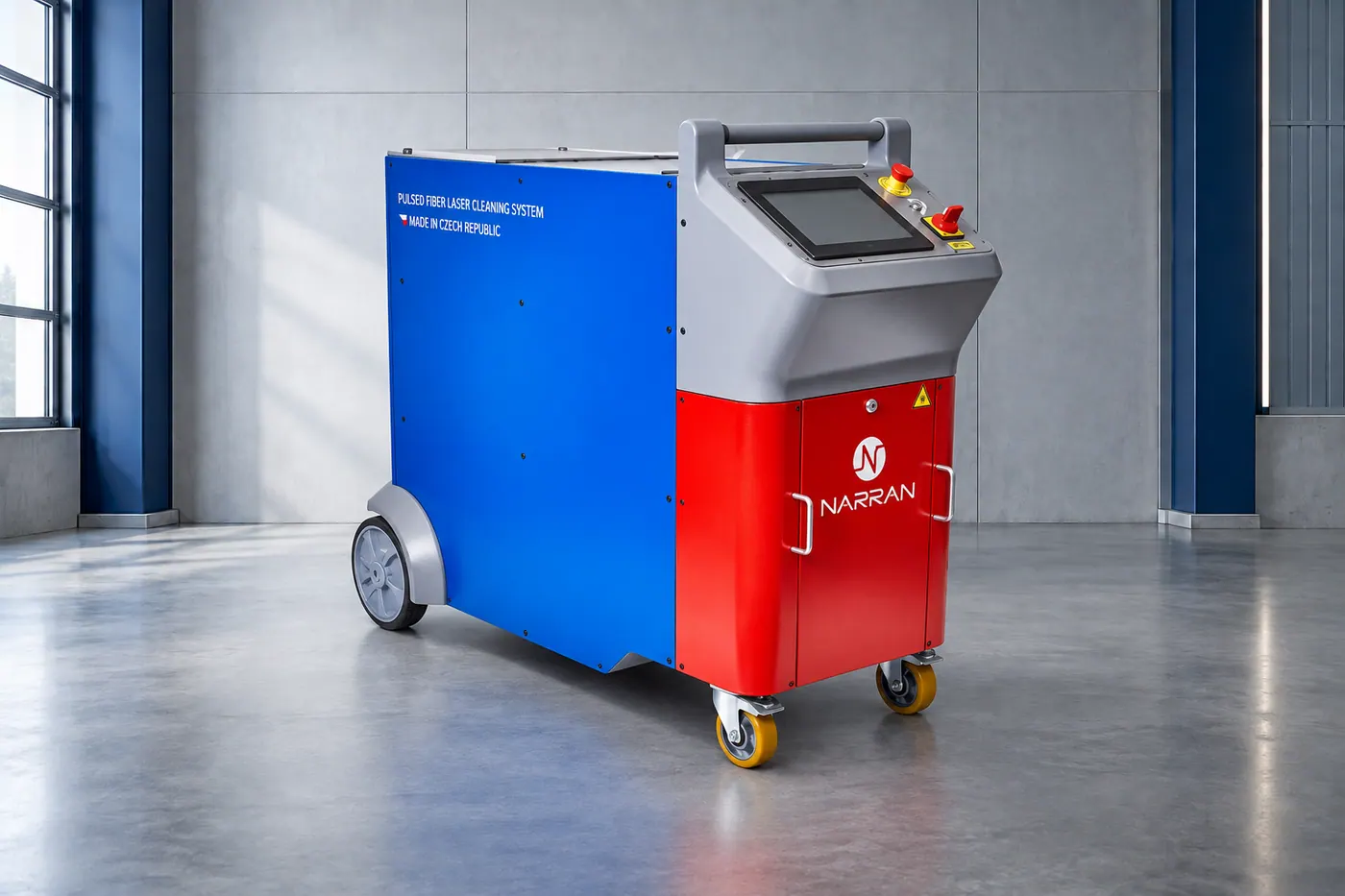
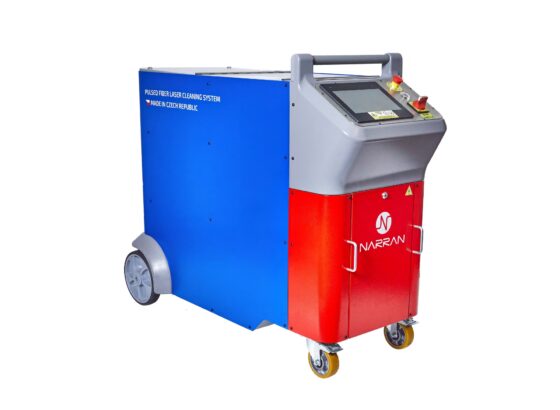
ROD 500: a pulsed 500 W laser cleaner with water cooling
ROD 500 works in pulsed mode with 500 W average power and, according to the manufacturer, is water-cooled. It weighs 240 kg, measures 140 × 64 × 112 cm and runs on 230 V at 50 Hz. The fibre is 10 m long, and the laser is Class 4. Unlike the water-cooled ROD 1000 and ROD 2000, which need a 400 V three-phase supply, it gets by with 230 V.
What 500 W can do
For the ROD cleaning systems the manufacturer names rust and paint as applications. How much area comes off per hour is best read from the spread of the published figures. A manufacturer of pulsed fibre lasers gives 1.9 to 5.3 m² per hour for 500 W on grade C rust, and 0.7 to 0.9 m² when stripping 100 µm of paint. Another manufacturer quotes 3 to 10 m² for paint with a 500 W system, without stating the coating thickness, plus 15 to 20 m² for degreasing and 5 to 10 m² for light oxide layers. Both describe other systems. The gap between them shows how little a single figure says about your task.
For moulds, power says little about whether the surface stays unchanged. Energy density decides that. Studies on cleaning chrome-plated tyre and vulcanising moulds worked with 100 and 500 W, and the window between a clean mould and a damaged chrome layer is narrow. The page on mould cleaning shows what is documented.
ROD 500 or ROD 500 Air?
Both are pulsed, have 500 W and a 10 m fibre, and run on 230 V. They differ in cooling, weight and size. ROD 500 Air weighs 40 kg and measures 61 × 52 × 57 cm, while ROD 500 weighs 240 kg and measures 140 × 64 × 112 cm. The published data does not say whether water cooling allows longer duty cycles or higher ambient temperatures. Put that question to the supplier before you plan for 200 kg more machine. Check door widths, lifts and floor loading at the installation site too.
When ROD 1000 is the better fit
More area or thicker coatings point to ROD 1000. The first manufacturer’s table gives 1.2 to 2.8 m² per hour at 1000 W for stripping 100 µm of paint, and 0.9 to 1.4 m² at 200 µm. At 500 W the figures are 0.7 to 0.9 and 0.2 to 0.5 m². In return, ROD 1000 needs a 400 V three-phase supply and weighs 250 kg.
The range also includes a variant, ROD 500 Bright+. The name alone does not establish technical differences. Ask to see the documentation for both versions and compare them on the same task.
Laser safety: metal reflects
At the start of processing almost all of the radiation can be thrown back, and corners, tubes or weld seams send it in unexpected directions. Shielding therefore has to be designed for the wavelength and power of the machine. Standing screens shield only to the side, so the laser area stays open above. The guide to laser safety in laser cleaning explains what an operation must put in place before first use.
What the ROD 500 quotation should contain
Before buying ROD 500, ask for the data sheet of the version quoted. Equipment, connections, protective measures and supply scope belong in the quotation as separate items, together with training and extraction. For this model, ask about the coolant and the maintenance of the water cooling as well. Describe the component, the coating and the area per job so that the quotation fits your task.
Questions about ROD 500
Does ROD 500 need a three-phase supply?
No. According to the manufacturer it is specified for 230 V at 50 Hz. Fusing and connection type are given in the connection data sheet for the configuration quoted.
Is ROD 500 a mobile machine?
At 240 kg it is much heavier than the air-cooled models at 39 to 40 kg. The operator still guides the head by hand. How often the machine changes site is worth settling before you choose between ROD 500 and ROD 500 Air.