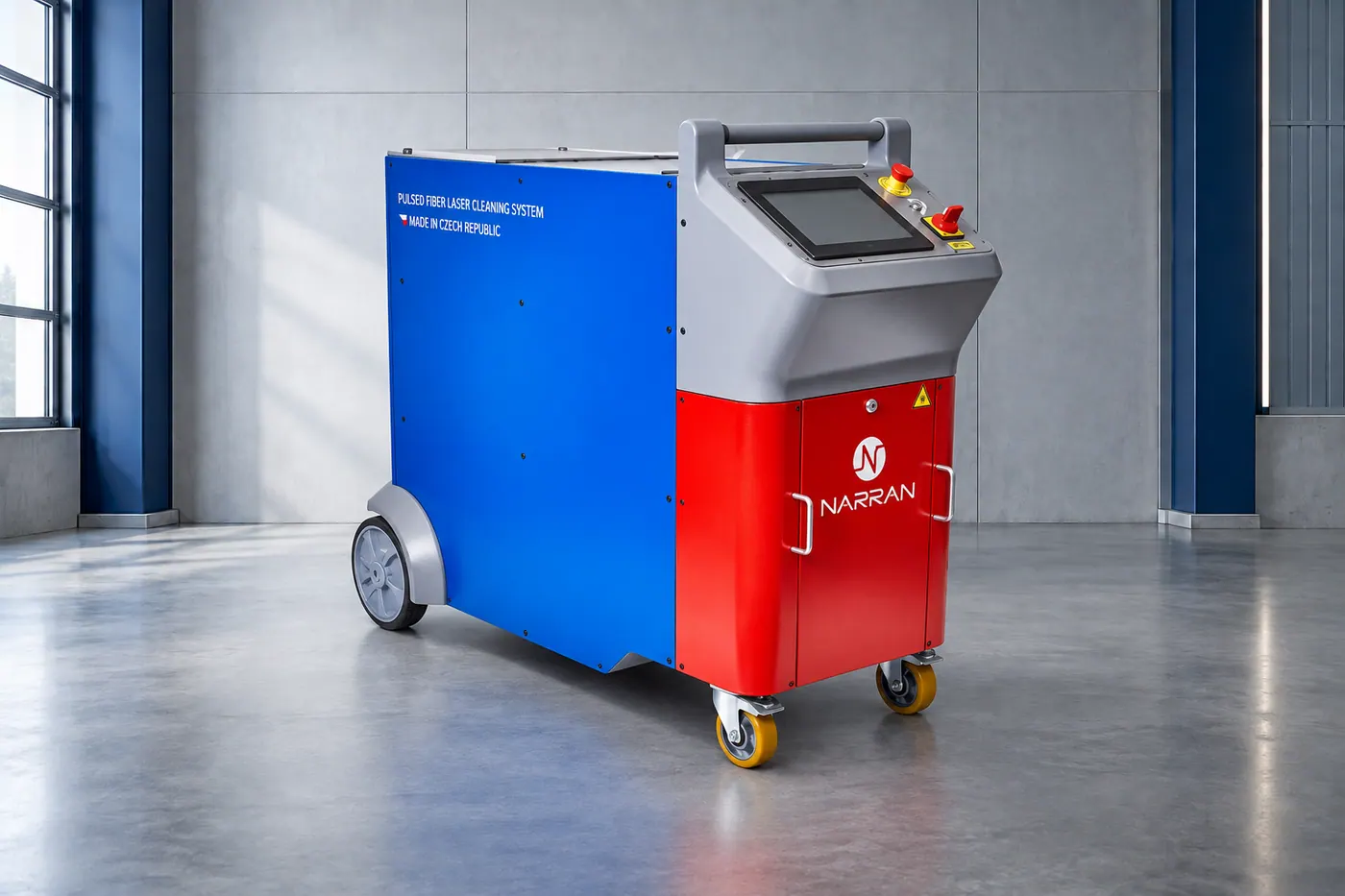
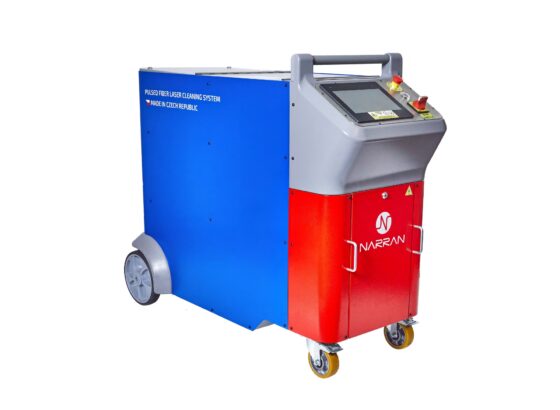
Key data according to the manufacturer
At 1000 W average power, ROD 1000 Bright+ is twice as powerful as the 500 W machines in the range. It works pulsed at 1064 nm, is water-cooled and needs a three-phase supply 3 + N + PE at 400 V and 50 Hz. Weight 250 kg, dimensions 140 × 64 × 112 cm, fibre 10 m, up to 100 m for special applications. Laser class 4. The manufacturer lists robot interfaces to KUKA, ABB, UR and Stäubli.
Bright+ means shorter pulses than ROD 1000
According to its data sheet, ROD 1000 works with pulse durations from 60 to 500 ns. On ROD 1000 Bright+ the range runs from 20 to 100 ns. Everything else, from output to power supply, is identical.
There is a trade-off behind this. Long pulses loosen thick, firmly bonded layers well. Short pulses keep the heat closer to the surface and suit thin films, oxides and sensitive base materials. The basics are on the page How laser cleaning works.
Where 1000 W with short pulses fits
Double the output pays off when a lot of surface has to be cleaned in little time: series parts in an automated cell, large moulds or sheet metal before coating. The short pulse range fits when only a thin layer has to come off these surfaces, such as oil, oxide or a release agent. For thick rust and heavy old paint, ROD 1000 remains the obvious comparison.
Plan the three-phase connection and the 250 kg weight into the layout of the workplace. A machine of this class usually stands in a fixed cell or is moved with a pallet truck.
Making the enquiry useful
Describe the part and material, the layer and its thickness, the area per shift and the cycle time, if there is one. Say whether a robot is available and which one. If you are choosing between ROD 1000 and ROD 1000 Bright+, ask about both and have the pulse setting for your layer named.
All models and their data are listed in the model overview.